






By continuing to browser our site and use the services you agree to our use of cookies, Privacy Policy and Terms of Use. You can change your cookie settings through your browser.
I agree


The Nanhuo River Site, located in Jinbo Township, Baisha Li Autonomous County, is the first Paleolithic archaeological site to be discovered in Hainan. The dig site is located on the north bank of the Nanhuo River, an upper tributary of the Shilu River. After the discovery of the site in 2023, an investigation and preliminary survey was carried out by a team of archaeologists, confirming the existence of cultural relics mainly dating to the Paleolithic Age.
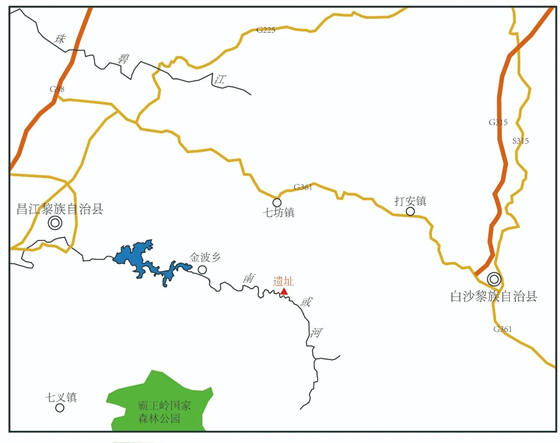
Map pinpointing the geographic location of the Nanhuo River Site (Photo courtesy of the Institute of Vertebrate Paleontology and Paleoanthropology, Chinese Academy of Sciences)
With the approval of China’s National Cultural Heritage Administration, the Institute of Vertebrate Paleontology and Paleoanthropology of the Chinese Academy of Sciences, the Hainan Provincial Institute Of Cultural Relics And Archaeology, and Sun Yat-sen University jointly conducted preliminary archaeological excavations at the Nanhuo River site from September to December, 2024.
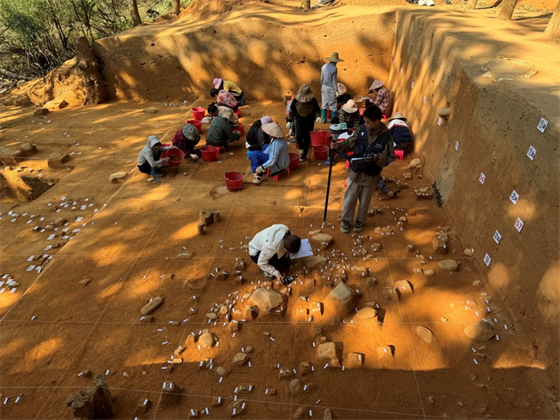
The Nanhuo River excavation site (Photo courtesy of the Institute of Vertebrate Paleontology and Paleoanthropology, Chinese Academy of Sciences)
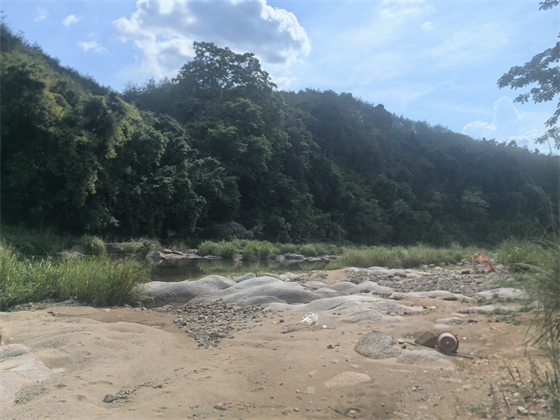
The Nanhuo River Basin (Photo: Liu Xiaohui / Hainan Daily)
So far, over 6,000 stone artifacts have been unearthed from the site and cataloged, and a total of over 20,000 stone artifacts have been sieved from the river and cleaned. In addition, a considerable amount of discarded fruit peels and charcoal debris has been found. Through optically stimulated luminescence dating, a preliminary determination was made that the site dates back to about 10,000 years ago.
The excavation has uncovered the remains of a fire pit and a well preserved site showing the marks of stone tool production. These discoveries, along with the many discarded fruit peels and other debris, show that ancient humans lived and produced items such as stone tools here.
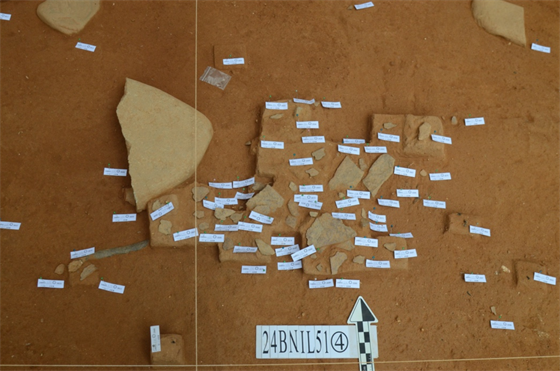
A site of stone artifact production (Photo courtesy of the Institute of Vertebrate Paleontology and Paleoanthropology, Chinese Academy of Sciences)
From the limited archaeological excavations and surveys that have been completed, it can be seen that the Nanhuo River Site is the largest, best preserved prehistoric wilderness site with the widest stratigraphic accumulation, the most cultural strata, the most significant cultural relics, and the clearest chronological sequences of any archaeological site so far discovered on Hainan Island. This important discovery adds to the number of different types of prehistoric archaeological sites in the province and brings more understanding of the cultural connotations of relics discovered in Hainan.
Based on preliminary observations, the stone tools unearthed at the Nanhuo River Site are characteristic of the southern China (Lingnan Region) pebble-tool industry, and are distinct from other stone tool techniques seen in southern China. These artifacts are comparable to a certain extent to the Hòa Bình culture of Southeast Asia, but also display unique local adaptations.
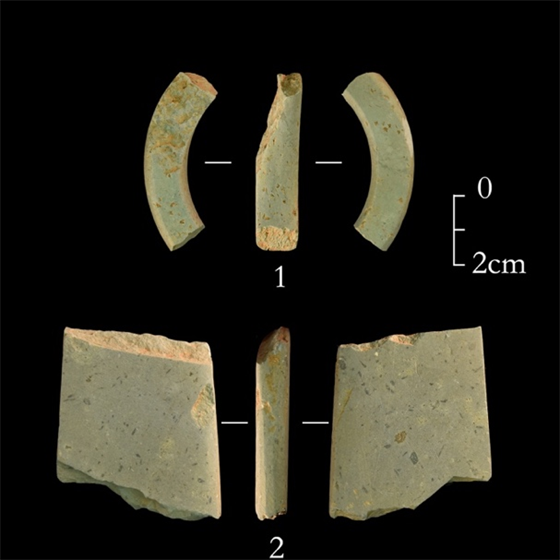
Polished stone tools discovered during the preliminary excavation (Photo courtesy of the Institute of Vertebrate Paleontology and Paleoanthropology, Chinese Academy of Sciences)
What is the significance of the archaeological discoveries made at the Nanhuo River Site? According to Hou Yamei, a researcher at the Institute of Vertebrate Paleontology and Paleoanthropology of the Chinese Academy of Sciences, the site features fairly complete evidence of stone tool making and other life activities of humans who lived at that time, providing important material for further research into the link between stone tool technique development and the Paleolithic environment. In addition, systematic archaeological surveys have shown that the Nanhuo River basin does not contain just one archaeological site, but instead holds a cluster of prehistoric settlements, providing a basis for further archaeological excavations and research on the river basin system. The site also provides an important archaeological framework for the study of population interactions and cultural exchanges in southern China and Southeast Asia, as well as showing wide-reaching academic value across a number of disciplines.
FTP Expert Talks | Xiaodong Lee, Vice President of the Internet Society of China and Founder of the Fuxi Institution: Hainan is the "Nebula" of New Digital Youth
09:47, 12-September-2025Hainan Issues Offshore RMB Bonds in HK for 4th Consecutive Year
09:46, 12-September-20252025 Hainan FTP International Students Content Creation Project
02:28, 12-September-2025What Makes "Hainan Travel" So Appealing?
09:38, 11-September-2025100 Days to Go: What's Next for Hainan-Hong Kong Cooperation?
09:38, 11-September-2025Expert Talks Ep. 4: The Future of the FTP's Digital Economy
09:35, 11-September-2025
By continuing to browser our site and use the services you agree to our use of cookies, Privacy Policy and Terms of Use. You can change your cookie settings through your browser.

Copyright © 2021 hiHainan.All rights reserved.琼ICP备09005000号-13
 thisishainan@163.com
Partner: Hainan College of Foreign Studies