
By continuing to browser our site and use the services you agree to our use of cookies, Privacy Policy and Terms of Use. You can change your cookie settings through your browser.
I agree


Due to an increase in brand value and a large number of exports, the price of Haikou’s Qiongshan Dapo Pepper has risen rapidly. This year, the price has gotten as high as 30 yuan per half kilo and is still on the rise, driving up the price of pepper in other cities and counties of Hainan. Pepper farmers are raking it in! However, compared to the prices hundreds of years ago, or even just two or three decades ago, today's prices are nothing. At that time, pepper was sold for over 100 yuan per half kilo, making it a luxury that only the elite could enjoy.
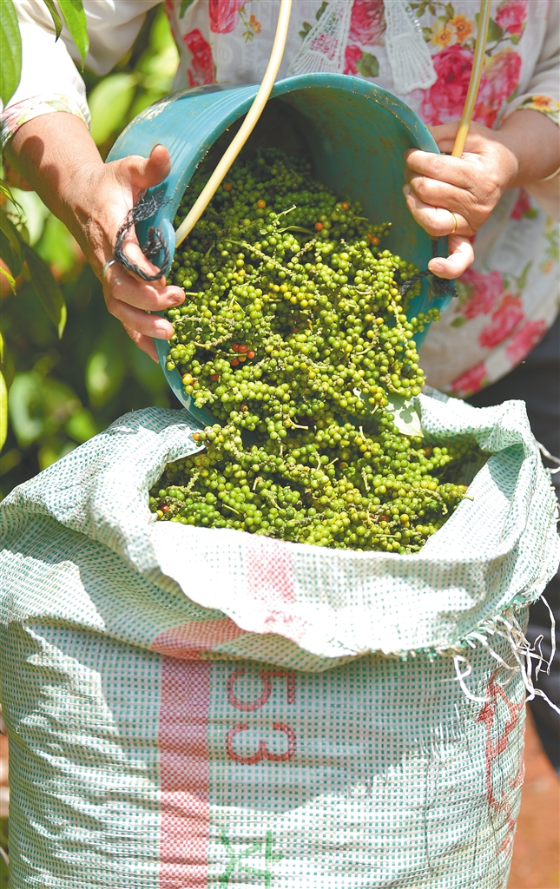
Dapo Pepper harvest. (Photo by Yuan Chen, Hainan Daily)
Small seeds put locals on the road to prosperity
In Dapo Town, pretty much every household is involved in pepper cultivation, and the same is true for many surrounding towns. Here, there are both huge standardized farms and small scattered plots of land.
Dapo Town and the surrounding area has a unique climate that is very suitable for cultivating pepper. The unique local red soil, which is acidic and has a high nitrogen content, gives the peppers a spicier taste and better texture.
Large-scale pepper cultivation has brought considerable benefits to the locals. Wang Suishan, who is over 60, recalls the 1990s with pride. At that time, he could earn three to four hundred thousand yuan a year from peppers, and lived a prosperous life. Millennial Yang Fa has become a well-known Dapo Pepper seller. He has his own pepper base and processing line. The pepper he purchases is sold as far as Dubai and Europe, and the daily shipment volume is calculated in tons.
Pepper was once regarded as the "Black Gold"
Not only in China, but also in Europe for a long time, pepper, like gold and silver, was a symbol of wealth and could only be enjoyed by the elite class. Pepper was once regarded as a substitute for "currency" and was hailed as "black gold".
In China, as early as the Xia and Shang Dynasties (2070 BC - 1600 BC), the use of spices, especially pepper, was a status symbol for emperors and nobles. During the Han and Jin Dynasties (202 BC - 420), pepper was brought to China via the Silk Road. During the Song and Yuan Dynasties (960 - 1368), the demand for pepper in China increased greatly and the pepper trade flourished. In 2018, thirty-one peppercorns, the earliest unearthed in China, were discovered on the sunken ship "Nanhai No.1", proving that at the latest in the early and middle 13th century, Chinese people had used pepper to season their food. The large-scale popularization of pepper in China began in the Ming Dynasty (1368-1644), nearly a hundred years earlier than in Europe.
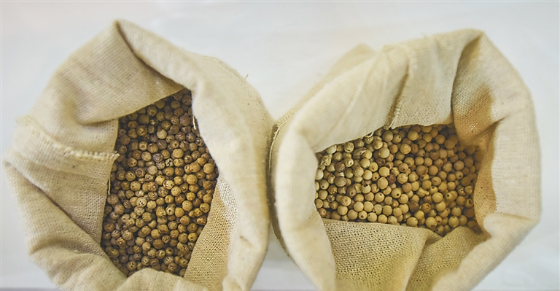
Dried pepper
Floating across the South China Sea to Hainan
The start of pepper cultivation in Hainan is largely attributed to overseas Chinese from Southeast Asia. In 1947, overseas Chinese Wang Yuwen brought back two pepper seedlings. One of them thrived and was hailed as the "King of Pepper", blooming and bearing fruit every year. In 1951, overseas Chinese Zheng Hongshu from Jiaxian Village, Tayang Town, Qionghai, brought back 16 pepper seedlings, which produced abundant fruit two years later. In 1956, technicians from the state-owned Dongping Farm took over the baton of pepper cultivation, bringing the crop to Dapo and many other towns in Hainan, and even to Yunnan, Guangxi, and other areas, making China one of the biggest pepper producers in the world.
Nowadays, in Dapo Town, Qiongshan District, Haikou, around 112 km.2 are under pepper cultivation. In the surrounding towns as well as in Wenchang, Qionghai, Wanning, Ding'an and other parts of Hainan, pepper is also widely grown. Hainan now has the largest area under pepper cultivation of all provinces in China, exceeding 220 km.2, with an annual output value of more than 3 billion yuan, supporting over 100,000 farming households.
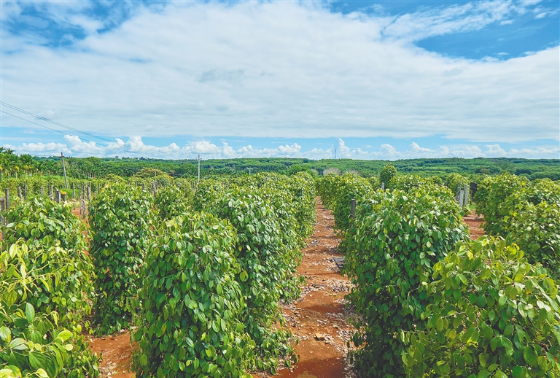
Hainan State Farms pepper field. (Photo by Feng Shuo, Hainan Daily)
FTP Expert Talks | Xiaodong Lee, Vice President of the Internet Society of China and Founder of the Fuxi Institution: Hainan is the "Nebula" of New Digital Youth
09:47, 12-September-2025Hainan Issues Offshore RMB Bonds in HK for 4th Consecutive Year
09:46, 12-September-20252025 Hainan FTP International Students Content Creation Project
02:28, 12-September-2025What Makes "Hainan Travel" So Appealing?
09:38, 11-September-2025100 Days to Go: What's Next for Hainan-Hong Kong Cooperation?
09:38, 11-September-2025Expert Talks Ep. 4: The Future of the FTP's Digital Economy
09:35, 11-September-2025
By continuing to browser our site and use the services you agree to our use of cookies, Privacy Policy and Terms of Use. You can change your cookie settings through your browser.

Copyright © 2021 hiHainan.All rights reserved.琼ICP备09005000号-13
 thisishainan@163.com
Partner: Hainan College of Foreign Studies