






By continuing to browser our site and use the services you agree to our use of cookies, Privacy Policy and Terms of Use. You can change your cookie settings through your browser.
I agree


Hainan tropical rainforest is the best-preserved, densest, most diverse, and largest contiguous continental island-type tropical rainforest in China and is an important component of the world's tropical rainforest system. Many of Hainan's unique animal and plant species call this rainforest home, making it a globally important gene bank of germplasm resources.
To celebrate World Rainforest Day, HIMC has created a set of "ID cards" to help you identify and learn more about some of the mysterious and wonderful animals that live in the Hainan Tropical Rainforest National Park.
Hainan Moss Mantis (Haania vitalisi)
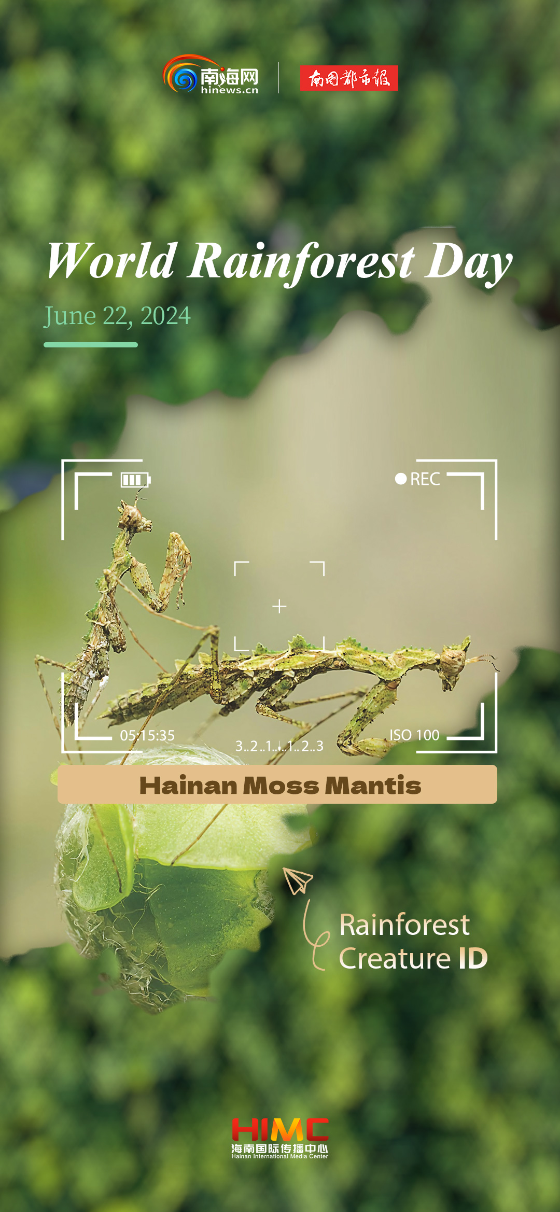
(Photo by Hainan Tropical Rainforest National Park official website)
The Hainan moss mantis is a relatively rare species of mantis with amazing mimetic features. Its small body, with green patches and protrusions, resembles a slither of moss, allowing it to fully seamlessly into the environment.
Characteristics: The Hainan moss mantis has a very unique shape, with a pair of ear-like protrusions on its head. These protrusions are actually antennae, a common feature of Asian praying mantids. There are also unique moss-like protrusions on the back of its thorax, and its middle and back legs are slender and long.
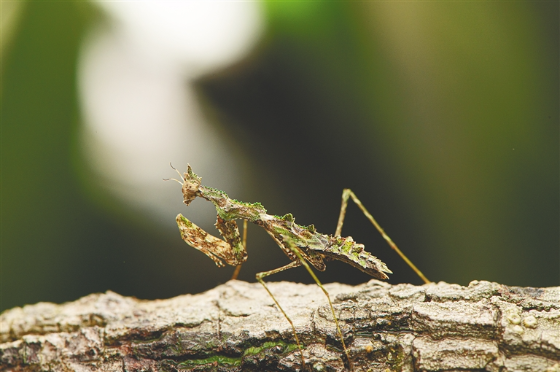
A Hainan moss mantis nymph waits on a branch for the right moment to strike. (Photo by Ge Yang)
Habitat and Behavior: The Hainan moss mantis lives in shaded areas of the tropical rainforest near streams. With its moss-like camouflage, the Hainan moss mantis can hide stealthily in moss patches. They usually stay in a small area and are rarely active, remaining stationary for several weeks to avoid detection.
Hainan Eld's Deer (Panolia eldii)
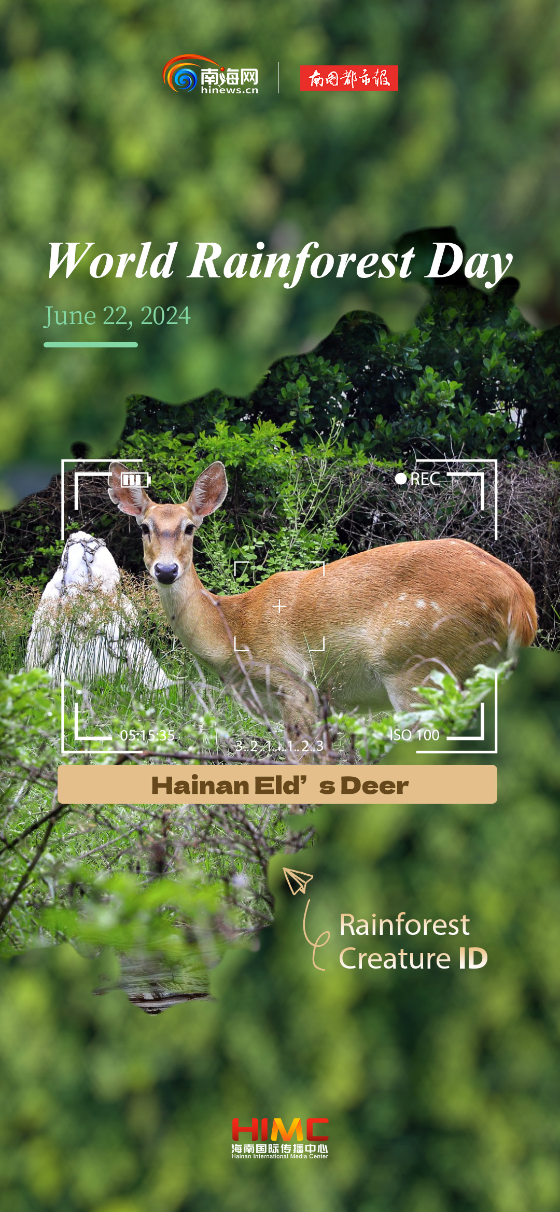
(Photo by Yao Hao, Hinews)
The Hainan Eld's deer, a subspecies of deer unique to Hainan, is a national first-class protected species. It is the most precious among the 17 deer species in China and is known as an "exotic treasure." The International Union for Conservation of Nature (IUCN) has classified it as endangered.
Characteristics: The Hainan Eld's deer superficially resembles the Sika deer, with reddish brown fur and antlers present on stags (male deer). They also have white spots, in this case, dotted in two neat rows on either side of a brown strip that runs down their backs. Stags' antlers have a large and curved brow tine (branch) connected to the curved main beam, forming what could be described as a bow shape. It is also known as the "brow tine deer" or "brow horn deer." Adult Hainan Eld's deer can grow up to 1.4 meters in length and weigh nearly 100 kilograms. Their vision is five times more powerful than that of humans, enabling them to see the slightest movements in the distance. Their damp, heart-shaped noses can adhere to fine particles in the air and perceive changes in the surrounding environment. They boast excellent jumping and running abilities, being able to jump as far as 6 meters in a single leap.
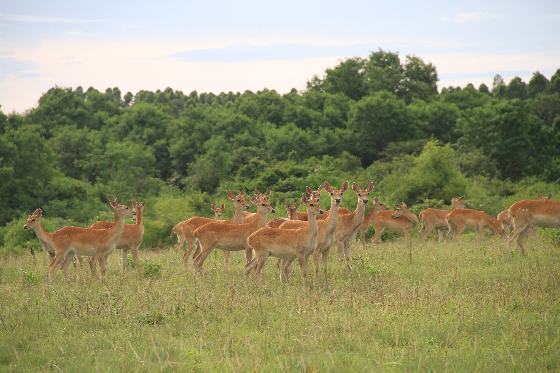
Hainan Eld's deer in the Dongfang Datian Nature Reserve. (Photo by Chen Weidong)
Habitat and Behavior: Hainan Eld's deer mainly inhabit hilly slopes or flat lands below an altitude of 200 meters. They are distributed within the limits of Bangxi Town in Baisha Li Autonomous County and Datian Town in Dongfang City. They prefer to eat tropical grasses, such as stylo shrubs and elephant grass, and sometimes also eat the tender leaves and stems of certain shrubs. They are very alert when foraging, taking two or three bites, and then lifting their heads to observe their surroundings.
Hainan Gibbon (Nomascus hainanus)
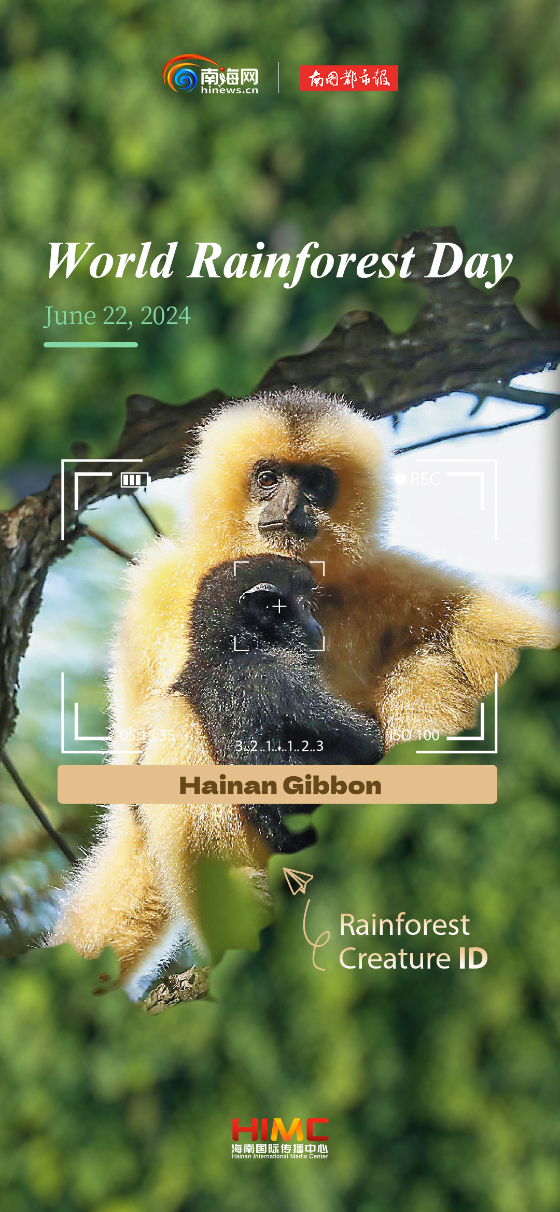
(Photo by Li Tianping, Hainan Daily)
The Hainan gibbon is a national first-class protected species and an indicator species of Hainan's tropical rainforest. Currently, it is only distributed in the Bawangling section of the Hainan Tropical Rainforest National Park, with just 42 individuals spread across 7 family groups. It is the world's most endangered primate.
Characteristics: The Hainan gibbon is similar to a monkey in appearance but without a tail and weighs about 10 kilograms as an adult. At birth, their fur is golden yellow but begins turning black after about six months. By the time they reach sexual maturity, they exhibit sexual dichromatism, whereby males and females have different fur colors. Adult males are black in color, whereas adult females are golden yellow.
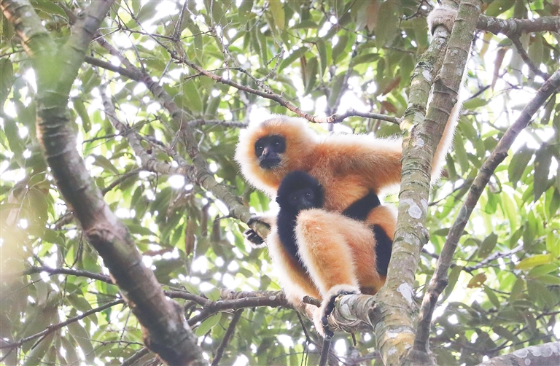
A female Hainan gibbon with her baby moves through the canopy in Futouling, Qingsong Township, Baisha Li Autonomous County. (Photo by Li Tianping, Hainan Daily)
Habitat and Behavior: Hainan gibbons generally live in family groups. They have strong upper limbs (forearms) and are very agile climbers, swinging through the forest canopy with ease. Every morning, they strike up their calls, which last between 3 and 20 minutes. These calls are clear and loud, traveling up to 3 kilometers. They feed on the fruits and tender leaves of plants such as wild lychee, fig, Lingnan garcinia, Jamun, Acmena acuminatissima, and yoog trees. They also occasionally feed on bird eggs and bee pupae.
Hainan Partridge (Arborophila ardens)
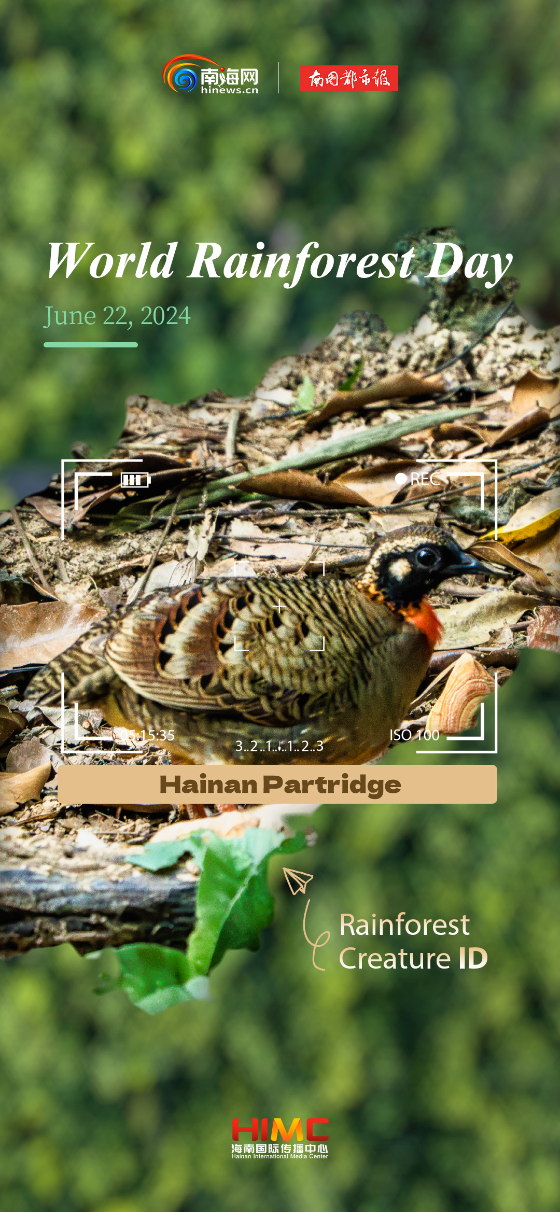
(Photo by Liu Sunmou, Hinews)
Unique to Hainan Island, the Hainan partridge is a national first-class protected species and is listed as vulnerable by IUCN. The Hainan partridge has a clear call with which mated pairs can also perform male-female duets. These partridges mind their own business, staying in their own territory and only making occasional "visits" to their neighbors. During breeding season, males will sing loudly, perhaps as a way of demarcating their territories.
Characteristics: Adult Hainan partridges are approximately 23-30 centimeters long. Their plumage is beguiling, with their lores, forehead, brows, cheeks, sides of their heads, chin, and throat all linked up in a uniform splash of black. Their upper bodies are olive-brown with black horizontal spots. Both wings are chestnut brown, and their belly feathers are brownish white.
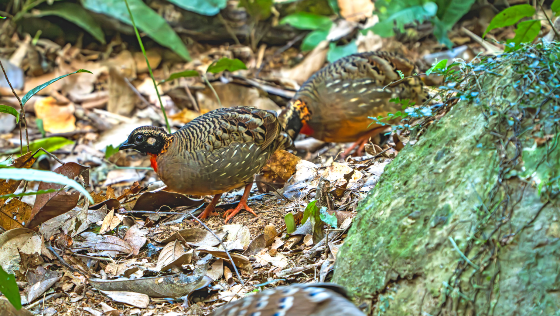
Hainan partridges foraging. (Photo by Liu Sunmou, Hinews)
Habitat and Behavior: Living in low-altitude mountainous and hilly areas, the Hainan partridge is more common in primitive mountain forest, valley forests, and mountain evergreen forest areas. Partridges live in mated pairs or in small groups of four or five, foraging at the bottom of ditches, at the foot of slopes, or on slopes with leaf build-up. They mainly feed on the leaves, buds, and seeds of shrubs and herbaceous plants, as well as insects.
Hainan Peacock-Pheasant (Polyplectron katsumatae)
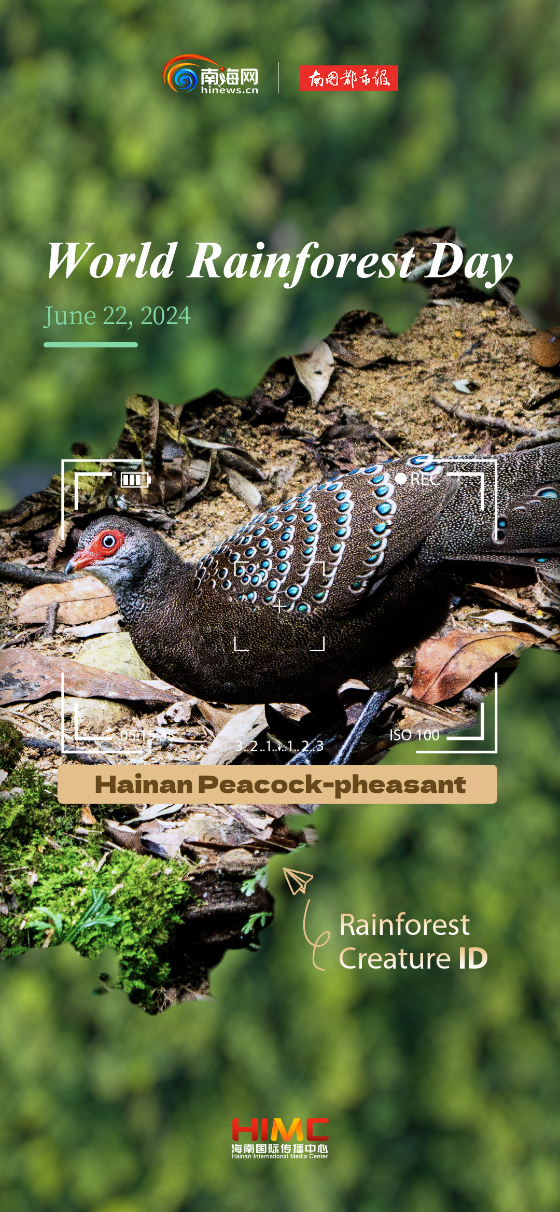
(Photo by Liu Sunmou, Hinews)
Listed as a national first-class protected species and endangered by the IUCN, the Hainan peacock-pheasant is endemic to Hainan Island.
Characteristics: This species of bird gets its name from its tail feathers, which resemble those of a peacock when fanned out and those of a pheasant when folded up. They range from 50 centimeters to 67 centimeters in length and from 456 grams to 710 grams in weight. The most obvious difference between the Hainan peacock-pheasant and an actual peacock is its smaller size. The tail of the Hainan peacock pheasant consists of 20 to 24 tail feathers, which are not very conspicuous when folded up. However, when males spread their wings, raise their tails, and spread out their tail feathers, shimmering eye-shaped spots are revealed – a beautiful sight to behold.

A Hainan peacock-pheasant foraging. (Photo by Liu Sunmou, Hinews)
Habitat and Behavior: The Hainan peacock-pheasant is extremely rare and can only be found in the central mountainous areas of Hainan Island. It is distributed in well-protected primitive forest areas such as Bawang Ridge, Jianfeng Ridge, Yingge Ridge, Diaoluo Mountain, and Limu Mountain. It is particularly fond of evergreen, broad-leaved forests and bamboo groves at altitudes of 150 to 1500 meters.
Hainan Leopard Gecko (Goniurosaurus hainanensis)
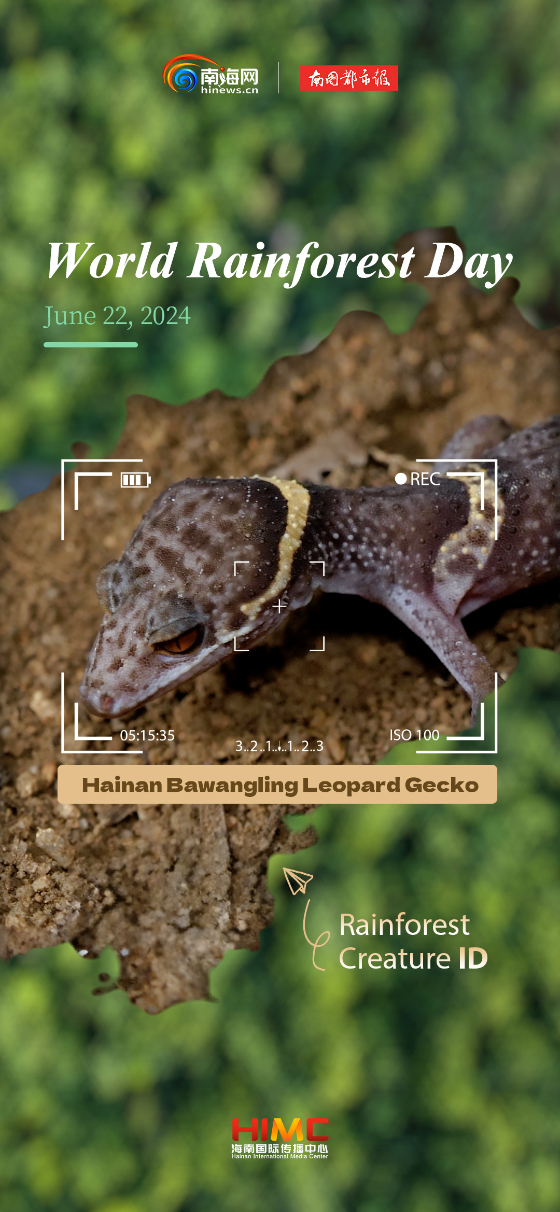
(Photo by Hainan Mysteries Camera Crew)
The Hainan leopard gecko is a lizard of the leopard gecko (Eublepharidae) family. It is a second-class protected species in China and is endemic to Hainan. In Chinese, it is named after its movable eyelids. Hainan leopard geckos have a gentle and placid personality. They are definitely more scared of humans than we should be of them.
Characteristics: The Hainan leopard gecko has a pink-purple body with obvious overlapping scales. Its back is dotted with brown stripes, and there are black warts (or spots) on the limbs. Its eyelids are prominent, and it has a piercing stare. The Hainan leopard gecko has a unique crawling posture. Unlike other lizards that crawl close to the ground, its four limbs suspend it above the ground, enabling it to strut in style.
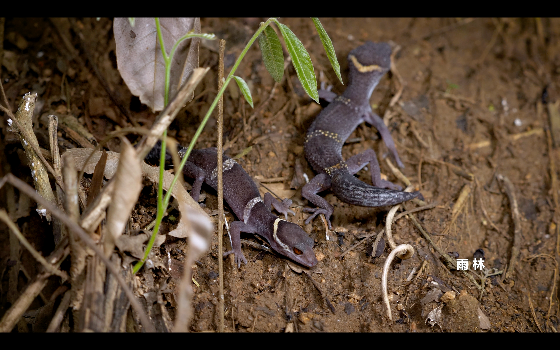
A Hainan leopard gecko (Photo by Hainan Mysteries Camera Crew)
Habitat and Behavior: Hainan leopard geckos are commonly found in crevices or caves on the banks of streams and rivers in the tropical rainforest. They enjoy cool, humid environments. During the day, they usually sleep under rocks or leaves or in crevices. At night, they come out to forage and so are also known as the "kings of the night."
Hainan Knobby Newt (Tylototriton hainanensis)
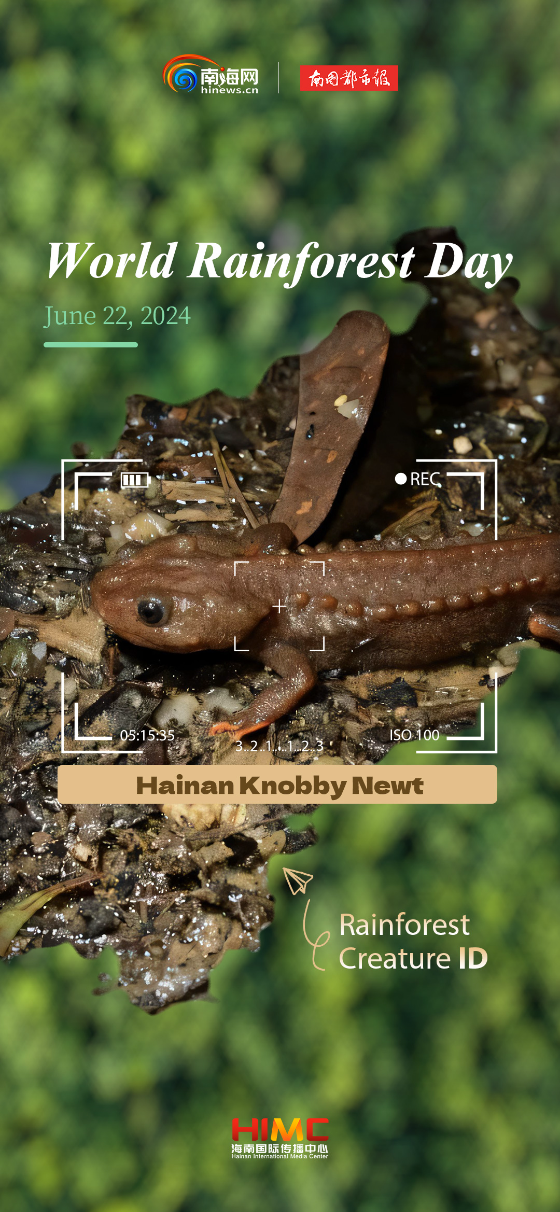
(Photo by Kadoorie Farm and Botanic Garden)
The Hainan knobby newt is an amphibian in the salamander (Salamandridae) family. It is the only tailed amphibian native to Hainan.
Characteristics: The Hainan knobby newt can grow up to 15 centimeters long and has a wide, flat head. Its back is covered with dense wart-like protrusions of brown or black color, with a row of 14-16 such protrusions on each side of the body. The chest and abdomen have fine constriction patterns, and the toes and bottom of the tail are dotted with a few orange-yellow patches.
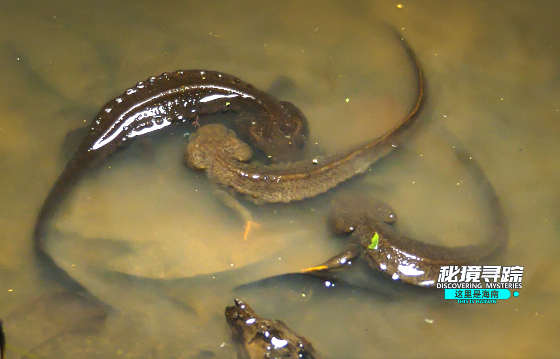
Male and female Hainan knobby newts engage in a mating ritual. (Photo by Hainan Mysteries Camera Crew)
Habitat and Behavior: Hainan knobby newts are distributed in the Qiongzhong, Lingshui, and Baisha areas of Hainan Island, with sightings recorded on Diaoluo Mountain, Jianfeng Ridge, and Wuzhi Mountain. They generally live in the roots, dead branches and leaves, or hollows of plants in the mountainous areas of the tropical rainforest at an altitude of 770-950 meters. After breeding, they become salamanders and live on land, feeding on earthworms, slugs, and other small animals. Hainan knobby newts: pose like a gecko, move like a lizard.
Yinggeling Tree Frog (Zhangixalus yinggelingensis)
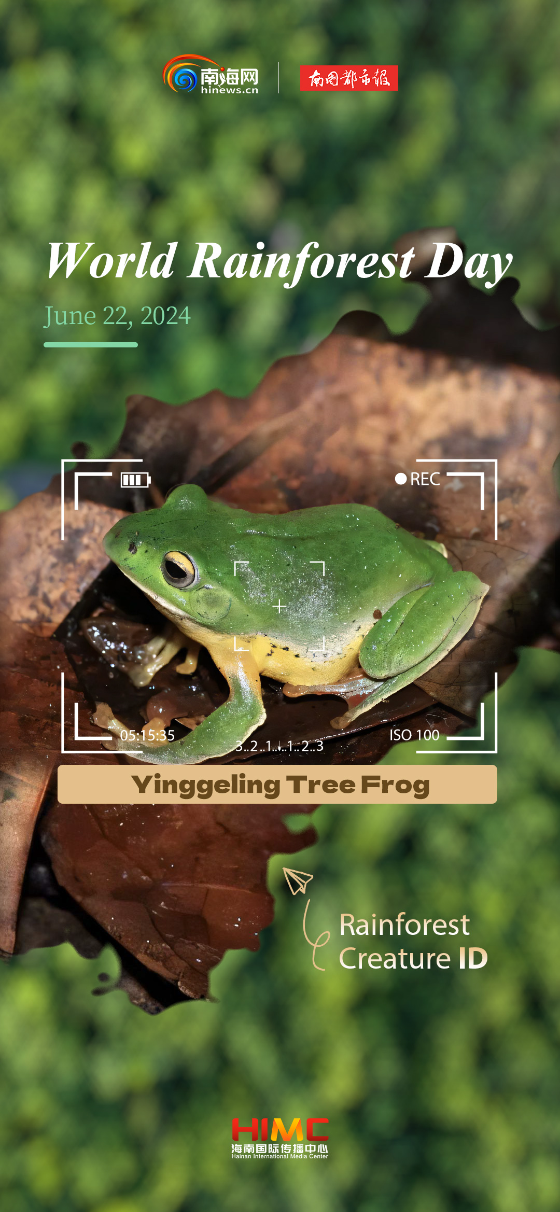
(Photo by Kadoorie Farm and Botanic Garden)
The Yinggeling tree frog was first discovered during a scientific expedition organized by the Hainan Provincial Forestry Bureau and the Kadoorie Farm and Botanic Garden. Once it was confirmed as a new species, it was named the place where it was discovered – Yingge Ridge.
Characteristics: The entirety of the Yinggeling tree frog's body is "clothed" in jade, its skin being green in color. Though it is diminutive, its certainly can make a racket. Its call is loud, deep, and drawn out, like the mooing of cows. In a rainforest where no chameleons are found, it takes on their role, with its skin appearing dark green during the day and light at night.
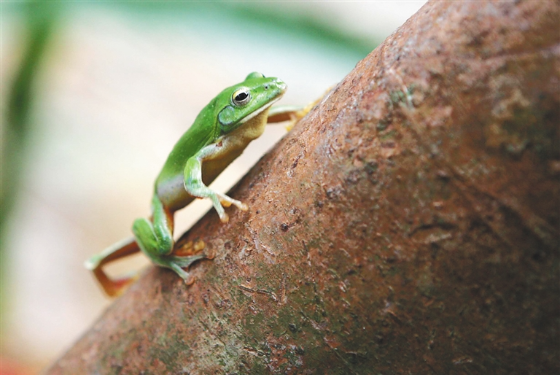
A Yinggeling Tree Frog. (Photo by Zhang Jie, Hainan Daily)
Habitat and Behavior: Yinggeling tree frogs are high-altitude organisms, inhabiting areas 1200 meters or more above sea level. They are very narrowly distributed and have a singular habitat - near seasonal water pools in high-altitude areas of the Yinggeling Nature Reserve.
Hainan Four Eye-Spotted Turtle (Sacalia insulensis)
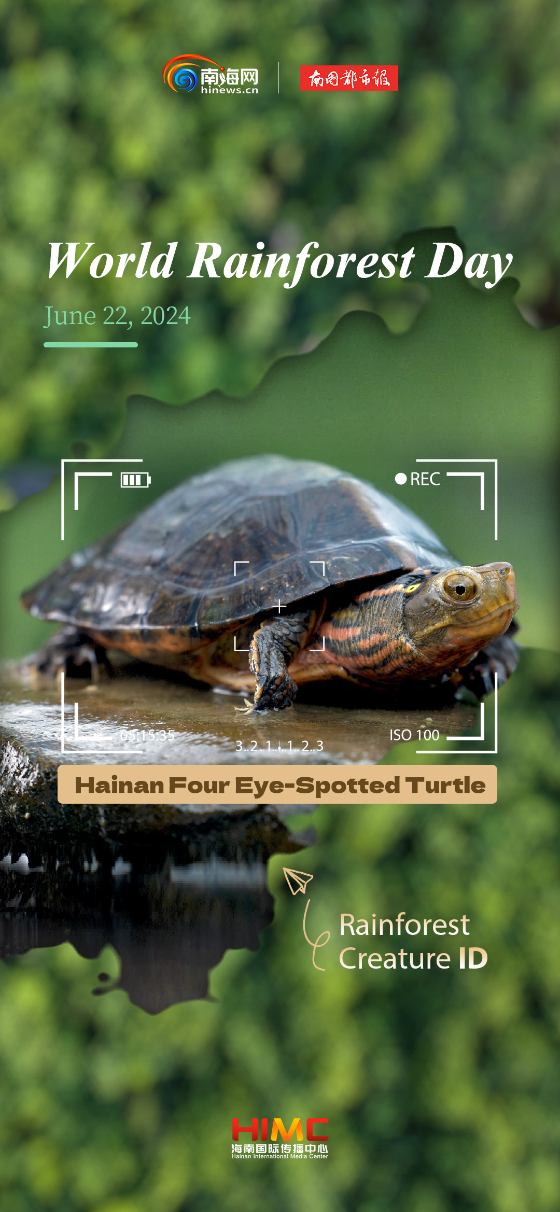
The timid Hainan four eye-spotted turtle belongs to the Sacalia family of turtles. Once startled, it immediately retracts its head, tail, and limbs into its shell or quickly escapes. Apart from its sturdy vertebral (back) and marginal (underside) shell, it doesn't have many defensive measures and spends most of its time hiding among rocks at the bottom of the riverbed.
Characteristics: The turtle has a smooth and scaleless head. It has a short, pointed snout extending beyond the chin and vertically downward towards the edge of its mouth. There are two pairs of vibrantly colored eye spots on the back of its head. It has a relatively flat vertebral shell; its nuchal (neck) shield is narrow and long, with the posterior edge wider than the anterior edge.
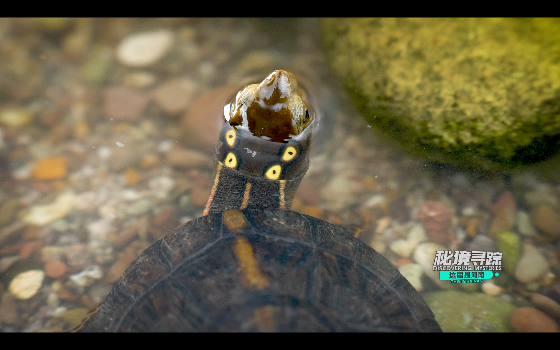
A Hainan four eye-spotted turtle. (Photo by Hainan Mysteries Camera Crew)
Habitat and Behavior: These turtles prefer to inhabit pools, ponds, and ditches in mountainous and hilly areas, often living in shaded places, such as under rocks or in tree roots. They have a diverse diet and a small appetite. They usually prefer animal-based foods and mainly feed on small fish, shrimp, and aquatic insects in the natural environment. When food is scarce, they also consume small wild fruits.
Information source: CCTV News App, Hainan Daily, Hinews, Hainan Tropical Rainforest National Park Management Office.
FTP Expert Talks | Xiaodong Lee, Vice President of the Internet Society of China and Founder of the Fuxi Institution: Hainan is the "Nebula" of New Digital Youth
09:47, 12-September-2025Hainan Issues Offshore RMB Bonds in HK for 4th Consecutive Year
09:46, 12-September-20252025 Hainan FTP International Students Content Creation Project
02:28, 12-September-2025What Makes "Hainan Travel" So Appealing?
09:38, 11-September-2025100 Days to Go: What's Next for Hainan-Hong Kong Cooperation?
09:38, 11-September-2025Expert Talks Ep. 4: The Future of the FTP's Digital Economy
09:35, 11-September-2025
By continuing to browser our site and use the services you agree to our use of cookies, Privacy Policy and Terms of Use. You can change your cookie settings through your browser.

Copyright © 2021 hiHainan.All rights reserved.琼ICP备09005000号-13
 thisishainan@163.com
Partner: Hainan College of Foreign Studies