

By continuing to browser our site and use the services you agree to our use of cookies, Privacy Policy and Terms of Use. You can change your cookie settings through your browser.
I agree


Recently, the Sanya School of Hainan Normal University has brought intangible cultural heritage into the classroom. Hainan's universities, secondary, and primary schools continue to find new ways to weave the province's intangible cultural heritage into the curriculum, bringing new life to ancient arts.
Fresh faces discover traditional heritage
Recently, traditional harmonies filled the halls of the Haikou Lingshan Town Central School as classical Bayin Instrumental Music was played by and for the students. “I began studying Bayin Instrumental Music when I was in the second grade, and now I can play in Bayin musical groups.” Feng Yuxuan, a fifth-grade student in the school, said that the Bayin Instrumental Music class is one of her favorites.
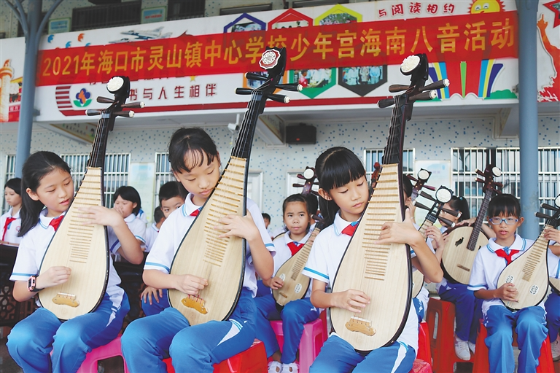
Students at Haikou's Lingshan Town Central School practice Hainan Bayin Instrumental Music. File photo.
In 2008, Hainan Bayin Instrumental Music was included on the second list of national intangible heritage arts. Lingshan Town, Meilan District, Haikou, is an important birthplace of this art form. “Our school has offered Bayin classes since 2012. We hope that through these classes, we can cultivate and inspire love for Hainan's local culture in both students and teachers,” said Huang Liye, chairman of the Lingshan Town Central School labor union.
At the Sanya School of Hainan Normal University, the bamboo pole dance is a favorite of teachers and students alike. “The school has brought in the bamboo pole dance and Li bamboo and wooden instrument music so that students can improve their physical fitness while also learning more about folk culture,” explained Chen Lixin, school principal.
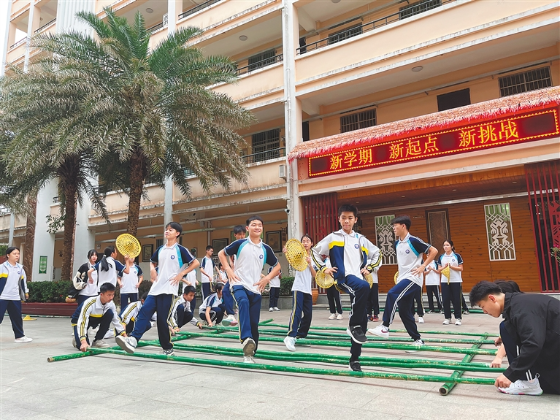
Hainan Normal University Sanya School students perform the bamboo pole dance. Photo: Wu Huiling
The school has also added the intangible cultural heritage of the Li people to art courses. “Art classes are themed around intangible cultural heritage, guiding students as they design clothing with Li cultural elements and tell Li stories through paper-cutting, allowing students to learn traditional skills as they create models of Li boat-shaped houses and experience the true beauty of intangible cultural heritage through a ‘play-do-create’ model,” said Wang Yanna, a school art teacher. Dong Weiwei, an eighth grade student, said that she's really benefited from the classes. “My teacher helped me to draw clothing designs incorporating Li cultural elements so that I could really feel how traditional Li culture and modern fashion intersect.”
Wuzhishan City's Hongxing School offers 18 intangible cultural heritage courses including Bamboo Pole Dance, Nose Flute, Li Brocade, Five Color Rice, and Fish Tea to inspire students to fall in love with Hainan's intangible cultural heritage. Primary and secondary schools in Haikou, Ding'an, Qionghai, and other parts of the province have created legions of ‘mini opera fans’ through Qiong (Hainan) Opera appreciation classes, Qiong Opera clubs, and other Qiong Opera campus activities.
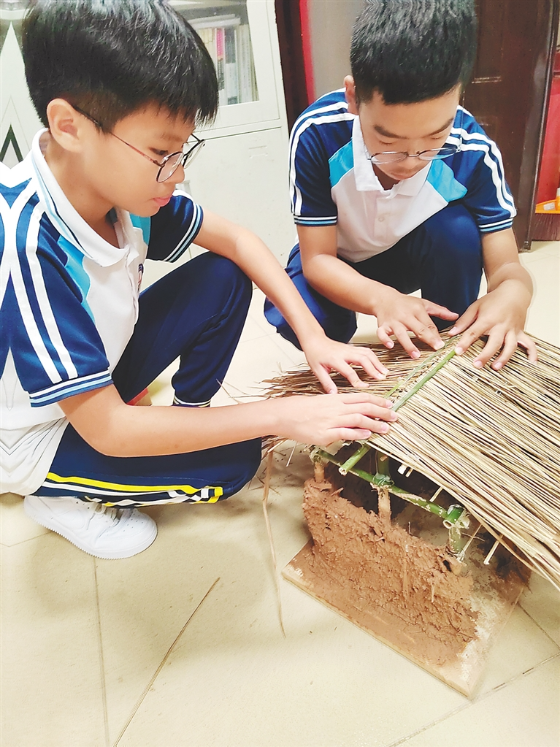
Hainan Normal University Sanya School students make a boat-shaped house model. Photo provided by the school.
In recent years, the Sanya University School of Art has established a research center for traditional Li spinning, dyeing, weaving, and embroidery techniques as well as held student clothing design competitions, allowing participants to see the beauty of Li culture up close.
The Hainan Tropical Ocean University School of Art offers special courses such as Li Bamboo and Wooden Instrument Performance and Li Folk Song Performance, allowing students and staff to dig deep into the meaning of Hainan's intangible cultural heritage arts. Hainan University and Hainan Normal University also offer Li Brocade related courses, and Hainan Medical College offers a public elective course on Li Brocade Weaving for undergraduates, bringing intangible cultural heritage into the classroom and making the transmission of these arts to the next generation a priority.
"Bringing intangible cultural heritage onto campus allows students to have close contact with and learn about traditional culture, deepen their understanding of the rich cultural heritage of the Chinese nation, and promote the passing down of intangible cultural heritage to the younger generation." said Wu Yongqing, a history education researcher at the Hainan Educational Research and Training Institute.
A new bloom on an ancient rose
“Currently, there has been some progress in bringing Hainan’s intangible cultural heritage into the classroom, but there are also some difficulties that can't be ignored, including institutional structure, professional teaching, professional education materials, and financial investment. These have restricted the in-depth development of intangible cultural heritage education,” according to Wu’s investigation.
How can campus intangible cultural heritage activities be improved so that new blooms can open on these ancient rosebushes? Wu believes that schools should clarify the goals and direction of intangible cultural heritage education and incorporate these in long-term educational development plans. Professional teaching teams should also be established, intangible cultural heritage teaching materials and resources should be developed, and teaching should become more professional and systematic.
“It's even more important to establish a multi-party cooperation system. Governments, schools, social groups, and companies should jointly participate in intangible cultural heritage education, implementing cooperative resource sharing and benefiting from complementary advantages so that intangible cultural heritage can better take root and sprout new leaves on school campuses,” said Wu.
FTP Expert Talks | Xiaodong Lee, Vice President of the Internet Society of China and Founder of the Fuxi Institution: Hainan is the "Nebula" of New Digital Youth
09:47, 12-September-2025Hainan Issues Offshore RMB Bonds in HK for 4th Consecutive Year
09:46, 12-September-20252025 Hainan FTP International Students Content Creation Project
02:28, 12-September-2025What Makes "Hainan Travel" So Appealing?
09:38, 11-September-2025100 Days to Go: What's Next for Hainan-Hong Kong Cooperation?
09:38, 11-September-2025Expert Talks Ep. 4: The Future of the FTP's Digital Economy
09:35, 11-September-2025
By continuing to browser our site and use the services you agree to our use of cookies, Privacy Policy and Terms of Use. You can change your cookie settings through your browser.

Copyright © 2021 hiHainan.All rights reserved.琼ICP备09005000号-13
 thisishainan@163.com
Partner: Hainan College of Foreign Studies