



By continuing to browser our site and use the services you agree to our use of cookies, Privacy Policy and Terms of Use. You can change your cookie settings through your browser.
I agree


As the first province in China to propose a province-wide ban on the sale of gas-powered vehicles by 2030, the popularity of New Energy Vehicles (NEV) in Hainan continues to increase. Last year, 20,938 new charging piles were installed in Hainan; more than 58,000 NEVs were put on the roads, and the number of NEVs accounted for nearly 7.2% of Hainan's total number of vehicles, placing the province ahead of the rest of China. In Haikou, the number of new charging piles installed in 2021 totaled 9,740, and a total of 32,100 NEVs were registered, reaching 217% of the original annual target. In total, the number of NEVs in Haikou reached 68,600. This year, Haikou plans to put 29,799 more NEVs on the road and install a further 11,320 charging piles.
Policy support, market recognition and perfecting the system - As NEVs technologies improve and charging infrastructure coverage becomes more complete, awareness and acceptance of NEVs have significantly increased among Haikou consumers. NEVs - be they private cars, taxis or buses - are bringing a newer, greener and lower-carbon way of life to Haikou.
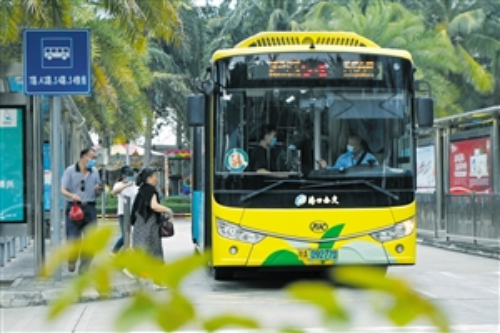
March 22 - locals board a new energy bus at the Evergreen Park bus hub in Haikou. Photo by HAIKOU DAILY APP.
Increasing the Momentum in Charging Infrastructure Construction
“It costs under 50 yuan to fully charge my car at the charging piles in my neighborhood, and for that I can drive almost 200km.” On the morning of March 18, Haikou resident Lin Rui disconnects the charging gun from his car before heading out to work. He said that by the time apartments in this community were delivered into the hands of owners, there were already more than ten parking spaces reserved for NEVs with charging piles installed, effectively solving the problem of charging NEVs for residents.
There's no denying that charging has become more convenient, and there are hard statistics to confirm this:
Statistics published by the Hainan Provincial Development and Reform Commission show that by the end of 2021, a total of 47,202 charging piles had been installed in Hainan, an increase of about 78.8% over the previous year. Within the province's 202 administrative divisions, charging pile coverage reached 93.6%. In 2021, 20,938 new charging piles were installed across Hainan, achieving 209.4% of the original annual target.
In addition to charging infrastructure, Hainan is actively carrying out exploration into battery swapping models. By the end of 2021, the province had 32 battery swapping stations up and running - equipped with a total of 1,087 battery units - for both passenger cars and commercial vehicles. Hainan's battery swapping architecture is beginning to take shape. There is currently 1 charging pile available for every 2.4 NEVs, with 1 charging pile for every 2.2 pure electric vehicles, outstripping the national vehicle-to-pile ratio. The symbiosis between installing charging piles ahead of demand and the popularization of NEVs has led to mutually-assured progress and support.
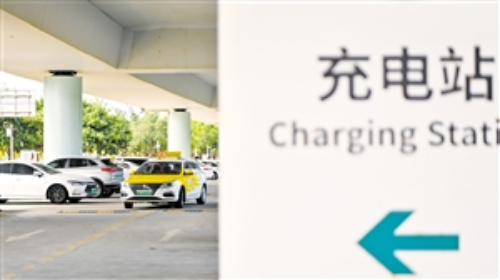
Haikou Century Park charging station provides convenient charging services for NEVs owners. Photo by HAIKOU DAILY APP.
Charging is an inescapable part of running an electric vehicle. In order to meet the rapid development of NEVs and the growing demand for charging, Hainan has recently decided to install 20,000 charging piles throughout the province in 2022, and will install charging piles in no less than 60% of residential communities. At least 6000 charging piles will be installed in residential communities, and cities, towns and villages will be required to achieve full charging pile coverage.
According to the plan, Haikou will install 11,320 charging piles this year, accounting for 56.6% of total charging piles planned, the highest number in the province. Haikou Comprehensive Free Trade Zone, Haikou National High-tech Zone, and Fullsing Internet Industrial Park will each install 20 charging piles, while Haikou Jiangdong New Area will install 30 charging piles.
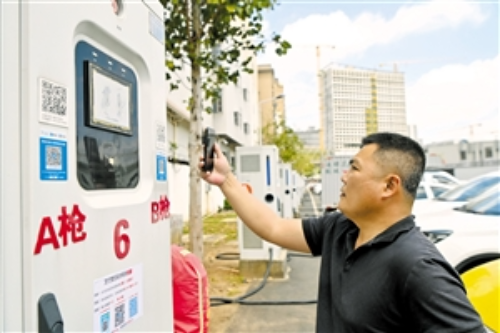
March 21 - a NEVs user initializes charging by scanning a QR code outside Haikou South Station. Photo by HAIKOU DAILY APP.
Haikou will also make full use of the available space under Century Bridge, in certain business districts and hotel parking lots to set up charging piles for car owners to use.
A multi-pronged approach to promote the uptake of NEVs
"At present, nearly 2,000 new energy taxis have been put into service in Haikou, accounting for 95% of the city's total taxis," said Wang Yuyong, Secretary General of Haikou Taxi Association.
In terms of clean energy in the field of public transportation, Haikou’s public transportation fleet is 100% new energy and runs on clean energy, occupying a leading position in the national urban public transportation industry.
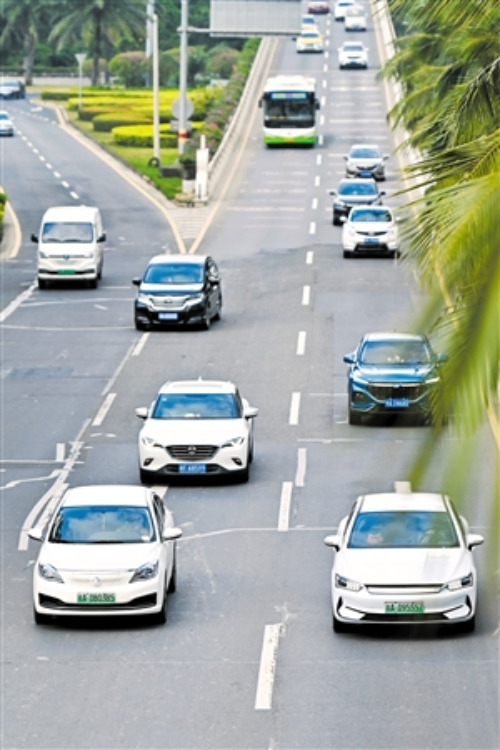
March 22 - NEVs driving along Binhai Avenue in Haikou. Photo by HAIKOU DAILY APP.
The convenience brought by NEVs to the masses is more directly experienced by online car-hailing drivers. Fu Chengxin, a car-hailing driver in Haikou did some calculations. If he were to cover 400 kilometers over the day in a gas-powered car, the cost of filling up would come to nearly 160 yuan. Now, covering the same distance in an electric car costs just around 60 yuan in charging, saving him a lot of money. To save even more, Fu also often charges during the off-peak hours after midnight to enjoy a discount of more than 40 cents per kilowatt-hour of electricity, resulting in lower operating costs and higher profits.
In recent years, Hainan has continued to do a good job in promoting NEVs. For the past three years, it has issued an annual plan for the promotion of NEVs across the province and issued an incentive policy to further promote the adoption of NEVs for the past two years. At the same time, an action plan for the promotion of NEVs in 2022 was formulated. It aims to promote greater adoption of NEVs in urban and rural areas, and to accelerate the construction of urban and rural green transportation systems. The construction of Mission Hills' Global New Energy Vehicle Experience Center project is also steadily progressing.
Meanwhile, parking has become a talking point for NEV owners. "In the past, it took a long time to find a parking space, but now many road sections in Haikou have dedicated parking spaces for NEVs, which makes parking a lot more convenient for me," explains Fu Chendong, a Haikou resident. Lately, Haikou has set up exclusive parking spaces for NEVs on Meiyuan Road, Longhua Road, Longkun South Road and other stretches of road with a relatively large traffic flow and high concentrations of NEVs.
To encourage more people to buy and use NEVs, Haikou has also implemented measures to make parking cheaper. According to one official at Haikou's Development and Reform Commission, vehicles with new energy green license plates can park for free in in public areas that have parking facilities, such as public schools and stadiums in the city. NEVs that park in paid parking lots for no more than 30 minutes will be exempt from vehicle parking fees.
Tackling New Energy Vehicle Development Problems Head On
Hainan's efforts in promoting NEVs have achieved remarkable results. Statistics show that from January to February this year, the province has seen 12,200 NEVs hit the roads, a year-on-year increase of 367.97% and more than double the national average, with the market drive continuing to strengthen. By the end of February this year, Hainan's NEVs ownership reached 133,600 vehicles, placing the province well ahead of the rest of China in terms of proportion of ownership.
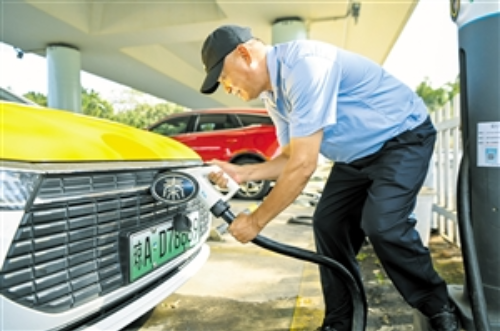
March 21 - a taxi driver charges his NEV at a charging station in Century Park. Photo by HAIKOU DAILY APP.
While NEVs are booming in Hainan, some urgent problems have surfaced. As clean energy reforms for road vehicles progress in the province, there are imbalances in the number of charging piles between cities, counties, districts and residential communities, as well as low rates of effective utilization.
“Considering the daily driving radius of NEVs and daily commuting needs, charging at home is the most convenient way to 'top up'," said an official at Hainan's New Energy Vehicle Promotion Center. If the charging problem is solved within the residential community, range anxiety among NEV owners will be greatly reduced. However, the introduction of charging piles into residential communities requires the collective efforts of many actors within the community. Relevant departments must fully solve problems such as insufficient electrical capacity, potential fire risks, a lack of enthusiasm from residential management companies, and low rates of direct meter reading.
In addition, the relatively slow progress of new energy in sub-sectors such as heavy freight vehicles, as well as gaps in the industrial chain, still restrict the high-quality development of NEVs in Hainan province, and there is a long way to go to in continuing to increase the penetration rate and ownership of NEVs.
According to information from the Haikou Municipal Bureau of Science, Industry and Information Technology, Haikou has comprehensively improved its electric vehicle charging capabilities by building a charging infrastructure service network covering the whole city. The possibility of constructing an "on-street temporary parking space charging infrastructure demonstration project" is being explored to solve issues of insufficient charging coverage and infrastructure planning and layout. The end goal is to gain experience that can be replicated and carried forward through the drawing up, issuing and implementation of the "Haikou on-street temporary parking space charging infrastructure demonstration project implementation plan".
In 2022, Haikou plans to put 29,799 more NEVs on the roads. Where does Haikou plan to place its focus in the promotion and market consumption of NEVs? According to an official at the Haikou Bureau of Science, Industry and Information Technology, charging infrastructure will be built to keep ahead of demand, with private investment in construction encouraged. There will be an increase in the supply of temporary parking spaces for NEVs. Events to encourage NEVs purchase in rural areas will also take place, starting with a special event in Haikou. Furthermore, 100% of all new and replacement official vehicles used by Haikou's party and government organs, state-owned enterprises and institutions as well as all new and replacement public transport vehicles will be NEVs. The only public vehicles exempt from this requirement will be emergency and special-purpose vehicles.
FTP Expert Talks | Xiaodong Lee, Vice President of the Internet Society of China and Founder of the Fuxi Institution: Hainan is the "Nebula" of New Digital Youth
09:47, 12-September-2025Hainan Issues Offshore RMB Bonds in HK for 4th Consecutive Year
09:46, 12-September-20252025 Hainan FTP International Students Content Creation Project
02:28, 12-September-2025What Makes "Hainan Travel" So Appealing?
09:38, 11-September-2025100 Days to Go: What's Next for Hainan-Hong Kong Cooperation?
09:38, 11-September-2025Expert Talks Ep. 4: The Future of the FTP's Digital Economy
09:35, 11-September-2025
By continuing to browser our site and use the services you agree to our use of cookies, Privacy Policy and Terms of Use. You can change your cookie settings through your browser.

Copyright © 2021 hiHainan.All rights reserved.琼ICP备09005000号-13
 thisishainan@163.com
Partner: Hainan College of Foreign Studies