





By continuing to browser our site and use the services you agree to our use of cookies, Privacy Policy and Terms of Use. You can change your cookie settings through your browser.
I agree


Have you ever read the book or seen the classic film Heidi, and been left with a deep longing for the alpine forests, mountain vistas, flower-filled grasslands, and chattering streams that the young girl inhabits with her elderly grandfather? The enchanting blue skies and white clouds above Graubünden, located in the Swiss Alps, served as the backdrop of the film. This year marks the 10th anniversary of the official friendship between Graubünden, Switzerland and Hainan, China. Green is also the predominant color of Hainan, the southernmost province of China. Let's take a look at some of the similarities and differences between Switzerland and Hainan in terms of their natural landscapes.
1. The Hainan Tropical Rainforest Park ✖ The Swiss Alps: Nature’s gifts: biodiverse, dense forests
The European Alps, which are regarded as gifts from nature, have long nurtured a wide variety of different species, as do the lush green jungles of the Hainan Tropical Rainforest National Park, located in China’s tropical Hainan Province. Let's explore the biodiversity of these two dense forest areas!
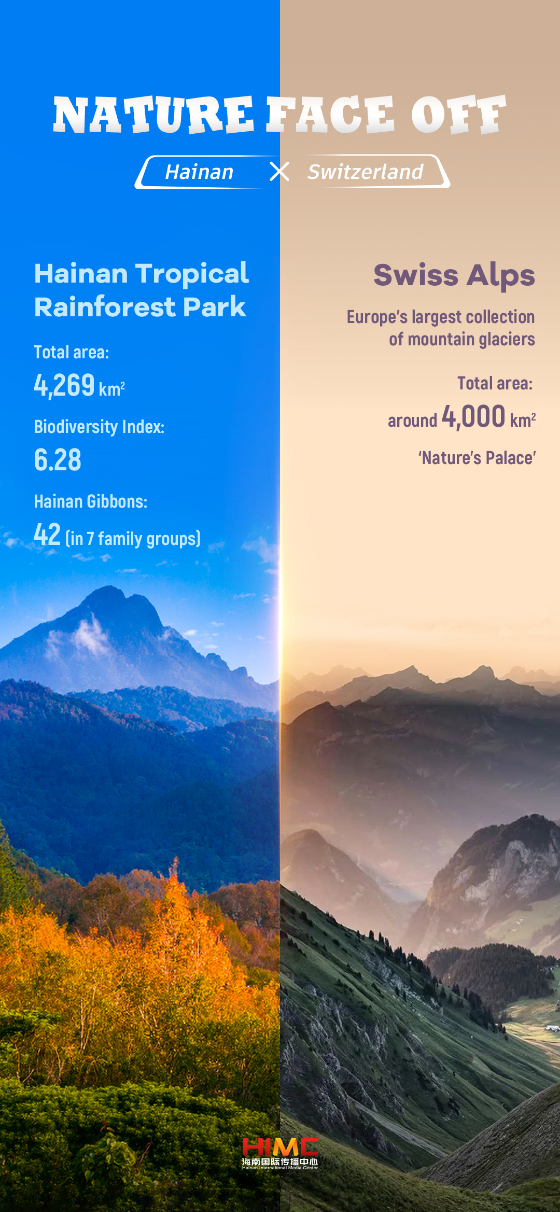
The Hainan Tropical Rainforest National Park
The Hainan Tropical Rainforest National Park, located in central Hainan, covers a total area of 4,269 km2. The core protected area stretches over 2,331 km2, accounting for 54.6% of the total park area. There are seven areas within: Wuzhishan, Yinggeling, Jianfengling, Bawangling, Diaoluoshan, Limushan, and Maorui.
The Hainan tropical rainforest is China’s densest, most bio-diverse, best preserved, and largest contiguous continental island tropical rainforest area, with a biodiversity index of 6.28, comparable to Brazil’s Amazon Rainforest.
Hainan’s tropical rainforests are extremely bio-diverse. The Hainan Tropical Rainforest National Park is home to 3,653 species of wild vascular plants in a total of 1,159 genera and 210 families. The Hainan Gibbon, the true ‘natives’ of Hainan Island, are considered an indicator species of the integrity and status of the Hainan tropical rainforest ecosystem. The gibbon’s survival rate reflects the health of the rainforest. As of June, 2024, the Hainan Gibbon population has grown to a total of 42 individuals in 7 family groups, showing an overall stable increase.
The Swiss Alps
The Alps are the tall, magnificent crown of Europe. They harbor the continent’s largest collection of glaciers, with over 1,200 glaciers covering a total area of around 4,000 m2, giving the area the nicknames ‘Nature’s Palace’ and ‘Geological Museum’.
Switzerland boasts over 230 natural habitats, including meadows, river banks, moors, forests, and even urban areas. The country is also home to an estimated 64,000 species of plants, fungi, and animals. Of these, 45,890 have been officially recorded. Switzerland owes its rich biodiversity to its varied climate and landscapes, with the number of species especially high in alpine regions and forests. Rivers and streams are also critical habitats for many rare species. Biodiversity is highly important for human well-being and the economy, and the Swiss government has put measures in place to protect and preserve the country’s natural heritage.
2. Bo'ao, Hainan, China (Near-Zero Carbon Demonstration Zone) ✖ Zurich, Switzerland (Smart City): Smart City & Green Low-Carbon Development
As we all know, protecting the environment protects humanity’s shared home. The development of ecological smart cities and the harmony of the relationship between urban development and ecological protection are issues worthy of careful attention and deep thought. The ‘Dual Carbon’ goals around the concepts of peak carbon and carbon neutrality are important strategies for the development of green, ecologically sound cities. Zurich, Switzerland, was named a ‘smart city’ in 2023, and the Near-Zero Carbon Demonstration Zone located on Dongyu Island in Bo’ao Town, Qionghai City, Hainan, began operation in 2024. How do they compare in terms of low-carbon and smart system development?
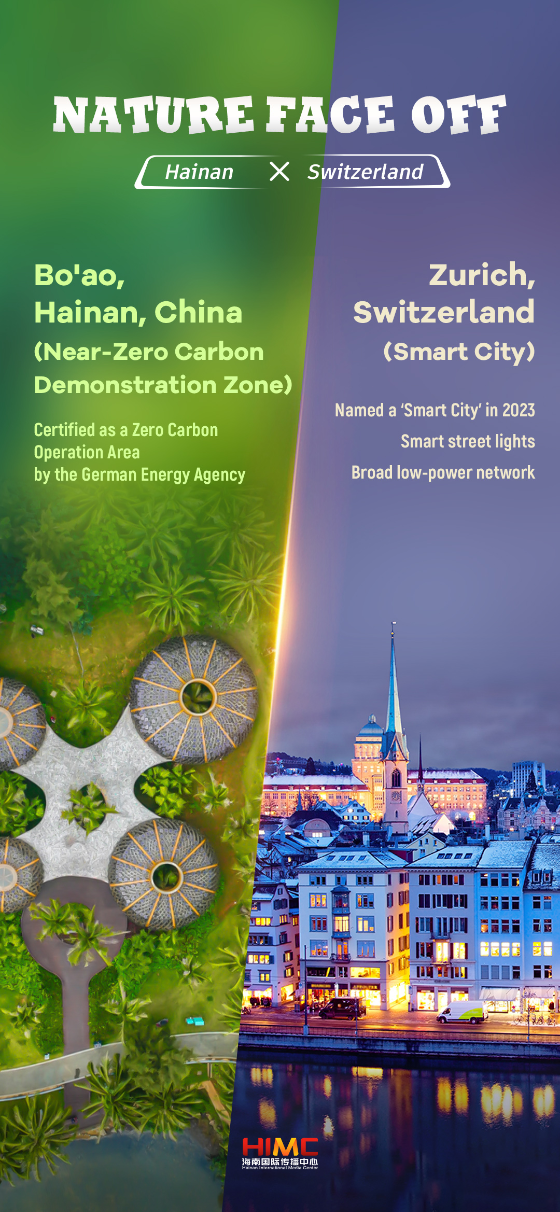
Boao Near-Zero Carbon Demonstration Zone in Hainan
The Boao Near-Zero Carbon Demonstration Zone, located on Dongyu Island in Qionghai’s Bo’ao Town, officially began operation on March 18, 2024. It was the first such demonstration project in China to receive CO₂-Neutral District in Operation certification from Dena, the German Energy Agency. Hainan has also published the technical standards for the development of the Boao Near-Zero Carbon Demonstration Zone in order to provide tropical regions located all across the globe a path towards green, low-carbon development.
In 2023, the zone achieved an approximate 11,000-ton reduction in carbon emissions, as certified by the China Environmental United Certification Center under the Ministry of Ecology and Environment.
Zurich (Smart City)in Switzerland
Zurich, the largest city in Switzerland located alongside the Alps, is a world-renowned financial center as well as a local cultural center. Before being named a ‘Smart City’ in 2023, it had already been highly ranked in many "livable city" surveys.
For Zurich, it all started with a streetlight project. The city set up a system of streetlights that adapted to traffic levels using sensors, and could raise or increase the brightness of the lights as needed, saving up to 70% of previous energy costs. Since then, Zurich has expanded the smart streetlight network across the city, and established a greater range of sensory technologies that collect environmental data, measure the flow of traffic, and act as public WiFi antennas. A smart building management system, which connects the city’s heating, electrical, and cooling equipment, has also been shown to be highly effective.
Zurich implemented a low-power wide area network that enables connectivity for Internet of Things technologies and other applications. Pilot projects include air quality and water level tests.
3. Dongzhai Port National Nature Reserve, Hainan ✖ Bolle di Magadino Nature Reserve, Switzerland: Wetlands - nature’s way of protecting sustainable development
Wetlands are home to large numbers of terrestrial and aquatic plant and animal species, forming a natural 'gene bank' unmatched by any other single type of ecosystem. The unique hydrological features, soil composition, and climates of wetlands create habitats where 20% of the earth's biological species live. What similarities exist between the Hainan Dongzhai Port National Nature Reserve, located in Haikou, China's southernmost province capital city, and the Bolle di Magadino Nature Reserve, located in the Swiss Delta region of Europe? What functions do they perform?
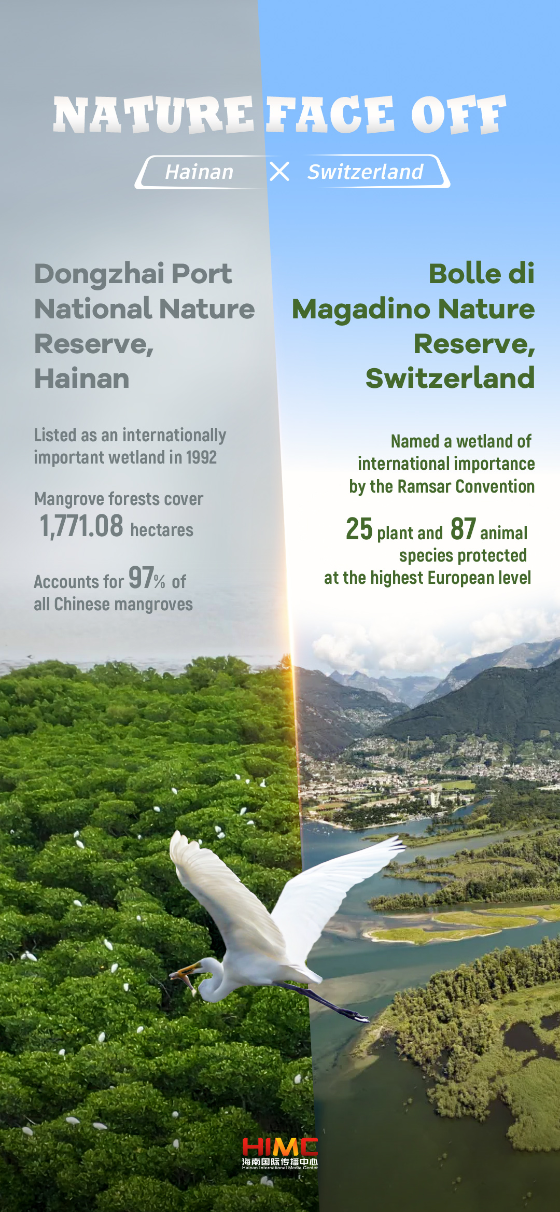
Hainan Dongzhai Port National Nature Reserve (Haikou Mangrove Wetlands)
The Hainan Dongzhai Port National Nature Reserve was the first mangrove reserve established in China, is the current largest contiguous mangrove reserve, and has the most mangrove tree species, the best forest quality, and the highest biodiversity rate in the nation. In 1992, it was listed as a wetland of international importance.
Hainan Dongzhai Port National Nature Reserve covers a total area of 3,337.6 hectares, with the mangrove area measuring 1,771.08 hectares. The reserve is highly bio-diverse, with 36 species of mangroves in a total of 20 families, accounting for 97% of all mangroves found within China. There are four species in two families of seagrasses, six species in five families of amphibians, 13 species in six families of reptiles, nine species in seven families of mammals, 214 species in 45 families of birds, 165 species in 61 families of fish, 151 families in 58 families of mollusks, 70 species in 21 families of shrimps and crabs, and 208 species in 66 families of insects, making the reserve a true treasure trove of nature.
Switzerland Bolle di Magadino Nature Reserve
The Bolle di Magadino Reserve is an internationally important wetland area due to its role as a stopover for many bird species on their annual spring migration routes north from Africa.
This area is more than just a swamp – it’s a “wetland of international importance” recognised by the Ramsar Convention, the first intergovernmental treaty on the conservation and management of natural ecosystems, signed in Ramsar, Iran, in 1971. It is also one of few protected areas of biodiversity in Switzerland.
Bolle di Magadino is one of the last near-natural river estuary landscapes in Switzerland. The site encompasses the estuaries of the rivers Ticino and Verzasca, which flow into Lake Maggiore, and 3.4 kilometres of the lake shore. Bolle di Magadino is characterized by a natural succession of vegetation types ranging from open water to mesophile forests, including groups of aquatic plants, reed beds, wet meadows, and alluvial forests. Habitats such as marshes with tall sedges, willow tree thickets, alder forests, and other riverine woodlands create an interlinked mosaic of remarkably rich, biodiverse, beautiful habitats.
The reserve is home to an impressive number of rare and endangered species, including some only found in Switzerland within the canton of Ticino. The Site harbours 54 plant and 154 animal species on the red lists of endangered species in Switzerland. An additional 25 plant and 87 animal species are protected at the European level. This is an important breeding area for many species of waterbirds as well as a significant stop-over and wintering ground for waterfowl.
Information Source: Hainan Daily, the Guang Ming Daily, the Hainan Provincial Committee of the Chinese People’s Political Consultative Conference, hinews.cn, aboutswitzerland Website,The Paper.cn, Earth.Org, GREATER ZURICH AREA, the National Forestry and Grassland Administration WeChat account, Ramsar Sites and the List of Wetlands of International Importance, swissinfo.ch, The Agenzia Turistica Ticinese.
FTP Expert Talks | Xiaodong Lee, Vice President of the Internet Society of China and Founder of the Fuxi Institution: Hainan is the "Nebula" of New Digital Youth
09:47, 12-September-2025Hainan Issues Offshore RMB Bonds in HK for 4th Consecutive Year
09:46, 12-September-20252025 Hainan FTP International Students Content Creation Project
02:28, 12-September-2025What Makes "Hainan Travel" So Appealing?
09:38, 11-September-2025100 Days to Go: What's Next for Hainan-Hong Kong Cooperation?
09:38, 11-September-2025Expert Talks Ep. 4: The Future of the FTP's Digital Economy
09:35, 11-September-2025
By continuing to browser our site and use the services you agree to our use of cookies, Privacy Policy and Terms of Use. You can change your cookie settings through your browser.

Copyright © 2021 hiHainan.All rights reserved.琼ICP备09005000号-13
 thisishainan@163.com
Partner: Hainan College of Foreign Studies