


For many retired passenger aircraft, the final destination is an aircraft graveyard on an isolated apron, where years of exposure to wind and sun gradually leave them rusting away before they are eventually scrapped.
In Haikou, capital of South China’s Hainan Province, though, new life springs up where you least expect it. Here, an Airbus A320 that has completed years of commercial service is embarking on a very different journey.
The first whole-aircraft dismantling project in the Hainan Free Trade Port was recently launched. Under the careful supervision of engineers, the A320 is undergoing a highly precise and systematic dismantling process.
In Hainan, an aircraft can now be dismantled and its components inspected locally before entering refurbishment, reuse, and re-circulation channels. From the old model of disposal as scrap to the new one maximizing the value of every component, a new circular aviation economy is taking shape in the FTP.
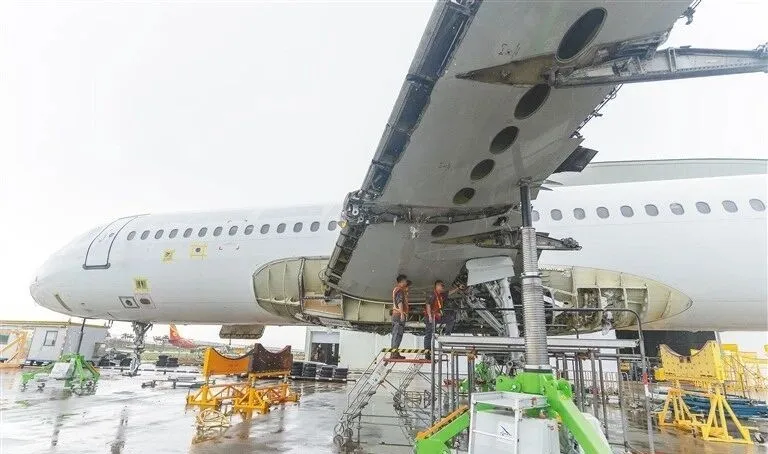
Recently, staff of Grand China Aviation Maintenance Company, a subsidiary of HNA Technic, worked on the aircraft at the apron of the New HNA Base at Haikou Meilan International Airport.
A Carefully Planned Retirement
On July 30, on the apron of the New HNA Base at Haikou Meilan International Airport, the A320, having completed its commercial service cycle, was lifted off the ground by four aircraft jacks.
The fuselage remained largely intact, while the vertical stabilizer had already been removed.
Sun Hao, an aircraft trading project manager at Grand China Aviation Maintenance Company, a subsidiary of HNA Technic, said that aircraft dismantling may sound to the general public like the disposal of an old car — cutting it apart and selling the metal for scrap.
In the civil aviation industry, however, aircraft dismantling is a highly specialized operation involving strict procedures, detailed technical standards, and stringent safety requirements. The process is more comparable to a high-precision surgery.
“Every screw and every structural component has to be removed in an ordered sequence,” said Yang Yi, an on-site support engineer. “It’s like taking apart a very complicated Lego set.”
Aircraft components must be dismantled one by one according to engineering drawings and operating manuals. For this A320, the customer identified nearly 1,000 sites requiring dismantling work, and about 96 percent of the work has now been completed.
One of the most technically demanding stages is the removal of the wings. One of the aircraft’s largest and most load-bearing external structures, the wings are not only massive and heavy, but also contain extensive networks of fuel lines, electrical wiring, and pneumatic systems.
During routine maintenance, an aircraft’s wings are not generally removed as complete units. Some fasteners may not have been opened for years and can become corroded or seized. Even preliminary access work, such as removing panels and opening inspection passages, takes quite some time. Fully dismantling an aircraft wing can take over ten days.
The entire aircraft dismantling project, however, is scheduled to be completed in just over 40 days, including component inspection, classification, and packaging, making the timetable particularly tight.
At the worksite, engineers must enter the wing through a small access hatch to carry out operations inside. The confined space can accommodate only one person at a time, making the work much more difficult.
Before dismantling officially began, the project team completed comprehensive preparations, including aircraft safety inspections, draining all residual fluids, electrical isolation, testing of onboard systems, and full environmental containment measures to prevent leakage.
The team was divided into seven groups, each responsible for major areas including the wings, engines, and landing gear. All components are dismantled by category, inspected, graded, and stored in designated areas.
Industry experts noted that aircraft dismantling requires highly specialized qualifications and technical capabilities. The successful launch of the Hainan FTP’s first whole-aircraft dismantling project demonstrates the capabilities of Hainan’s aviation maintenance sector in aircraft end-of-life management.
Understanding the “Green Economy” Behind Retired Aircraft
The civil aviation industry has its own unique economics of aircraft retirement.
Sun said an aircraft does not have a fixed commercial service life. As it ages, fuel consumption and failure rates increase while maintenance costs rise sharply. At a certain point, continued commercial operation becomes increasingly uneconomical.
“That’s when the value of dismantling an aircraft into components can exceed the value of keeping it intact,” Sun said.
An aircraft can contain tens of thousands of components, and they age at different rates.
The landing gear, engines, and key avionics systems generally have longer service lives and higher residual values, making them highly sought-after assets in the aviation market. Many small and medium-sized airlines and maintenance companies have steady demand for such components.
Cabin seats, galley equipment, windows, and control panels, meanwhile, often have relatively low levels of wear and broad applicability. After refurbishment, many can be returned to service.
Some aircraft fuselages are also made with advanced composite materials which can be recovered as high-value industrial materials, offering significant environmental benefits.
“The landing gear, engines, and APUs (auxiliary power units) are the three most valuable types of components in aircraft dismantling,” explained Sun.
In addition to the nearly 1,000 components specified on the dismantling list, the client has requested that all other removed aircraft components be boxed and packaged for further use, without leaving anything behind.
Through this process, a retired aircraft can move beyond the traditional model of disposal and waste, with components repaired where possible, reused where appropriate, and recycled when necessary.
The approach minimizes waste generated during aircraft dismantling and helps create a more complete circular system for aviation materials.
“Aircraft dismantling is not an end-of-life disposal industry. It’s a high-end circular economy,” Sun said. “The greatest value of the circular aviation economy is turning dormant assets into active ones and allowing every retired aircraft to continue creating value for the industry.”
Setting Up a More Complete Aviation Industry Chain
In recent years, Hainan’s aviation maintenance industry has gained increasing international recognition. Services ranging from bonded aircraft maintenance and scheduled checks to livery painting, modification, and upgrades have continued to expand.
With the launch of the Hainan FTP’s first whole-aircraft dismantling project, Hainan has taken another step toward completing the local aviation industry chain.
This new business effectively adds an “aircraft recycling center” to Hainan’s existing aviation ecosystem, helping close the remaining gap in a full industry chain covering aircraft maintenance, modification, repair & overhaul, whole-aircraft dismantling, and the recycling and reuse of aviation components.
The event also marks a significant transition for Hainan’s aviation industry — from a focus on individual maintenance services toward a more sophisticated, full-chain, circular development model.
The regular operation of aircraft dismantling services is expected to generate further industrial clusters.
As the dismantling business develops, supporting sectors including aviation material warehousing, component inspection & certification, aviation material trading & leasing, aviation finance, and specialized aviation logistics are expected to rapidly develop more industry clusters in Haikou.
In the future, more retired aircraft from China and other parts of the world will come to Hainan for retirement and find new uses here, helping Haikou develop into a regional center for aircraft dismantling, aviation material circulation, and the broader circular aviation economy.
Together, these businesses will form a new circular aviation economy industry chain.
Across China, the circular aviation economy remains a largely untapped market.
As the country’s civil aviation fleet gradually enters a period of large-scale retirement, an accelerated cycle of fleet renewal and replacement is expected to begin in the coming years, creating significant potential for aircraft dismantling and the reuse of aviation materials.
The Hainan FTP’s combination of policy advantages provides favorable conditions for the development of aircraft dismantling and aviation maintenance businesses.
Thanks to the FTP’s zero-tariff policies, low tax rates, and streamlined customs procedures, aviation components recovered through aircraft dismantling in Hainan can potentially circulate more efficiently across China and serve markets in Southeast Asia, helping create a competitive regional system for aviation maintenance and aviation material trade.
From maintaining aircraft to dismantling them, from servicing individual aircraft to unlocking the value of an entire industry chain, and from supporting the industry to helping lead a new sector, the journey of this retired A320 offers a vivid glimpse into the high-quality transformation of Hainan’s aviation industry in the context of the Free Trade Port.

Inira from Russia Celebrates Mid-Autumn Festival in Hainan
23:41,25-September-2026
Hainan Through Culture: Mid-Autumn Festival – Moonlight, Lanterns, and Island Traditions
19:36,25-September-2026
Remote Sensing + Al: Why Hainan Is Drawing Commercial Space Companies
19:36,25-September-2026
Why Global Entrepreneurs Are Investing in Hainan?
19:36,25-September-2026
The Three-Body VR: I Walked Right In a "Chaotic Era" at GDTE
19:36,25-September-2026
Moonlit Cruises, Live Music, and Family Fun in Haikou Bay
19:36,25-September-2026

Copyright © 2021 hiHainan.All rights reserved.琼ICP备09005000号-13
 thisishainan@163.com
Partner: Hainan College of Foreign Studies