


Jinhua Village has stood by the shore of Hongcheng Lake in Haikou City, Hainan Province for nearly six hundred years. The village's name comes from a poem by Qiu Jun, a politician of the Ming Dynasty (1368-1644, AD).
The land here was once given to the poor, and the nearby waters sustained generations of villagers. Today, this historic village, now surrounded by the bustling city, still retains traces of antiquity.
In 1454, Hainan native Qiu Jun earned the prestigious title of "Jinshi", the highest rank in China’s imperial civil service examinations, and departed for a government career in the north.
Since it was difficult for him to return, his nostalgia eventually crystallized into verse: "Too old and too homesick—in my dreams, I am always back in Hainan."
On rare visits home, he left several tangible marks, like building the "Snake Bridge" over the Nandu River to mitigate flooding and erecting rest pavilions for weary travelers.
Yet, what the locals recount most fondly is his petition to the Emperor for a piece of "One-Glance Land"—which consisted of the entire area he could survey from a single vantage point in his home village of Xiatian. He distributed this land to poor neighbors for farming, writing:
"If anyone asks where my home is—it is Xiatian, full of orange trees and golden flowers."
From that gesture, Jinhua (Golden Flower) Village was born, a name that has endured for nearly six centuries.
Despite its name, the village does not boast fields of golden flowers. It honors a woman surnamed Jin, Qiu Jun's first wife. For seven years, she was his pillar of support, encouraging his studies and caring for his mother. She passed away before witnessing his academic triumph. Qiu Jun never forgot her, writing later,
"Who says the bones beneath the earth have been there for ten years? They still appear vividly in my dreams."
Villagers have long passed down the story: the "Golden Flower" was Jin herself.
In 1514, Hai Rui, the legendary incorruptible official, was born in Zhujili, a hamlet adjacent to Jinhua. Zhujili was once known as Kumquat Lane. Local lore suggests that when Qiu sought to survey his "One-Glance Land", a dense grove of kumquat trees blocked his view, hence the name. Decades later, following Hai Rui's passing in Nanjing, a local named Xu Ziwei escorted the coffin back to Hainan, standing vigil at the grave for three years. Since then, the trio—Qiu, Hai, and Xu—have been celebrated as the "Three Sages" of the region.
Jinhua Village, Zhujili, and neighboring Beisheng Street formed the western district of the historic Fucheng area. For generations, the low-lying wetlands surrounding them dictated the rhythm of local life.
In the 1960s, these wetlands were excavated into a lake and stocked with the "four major Chinese carp"—black, grass, silver, and bighead carp. As Fucheng had been renamed "Hongcheng Commune" at the time, the reservoir became known as Hongcheng Lake.
"In those days, protein was a luxury, and fish from Hongcheng Lake were a delicacy across Haikou," recalls He Jinxing, party secretary of the Fucheng community. He remembers elders saying that no banquet in Fucheng was complete without a catch from the lake. For the youth of Jinhua, Zhujili, and Beisheng, the lake was their lifeblood, providing a good living from the north gate all the way to the south gate of the village.
After high school, Han Zhixin joined the Hongcheng Lake fishery. "We would row out at dawn, hauling nets brimming with leaping fish," he recalls. The elderly and widowed were first in line for the best catch, and the surplus was sold to support struggling families. When thirsty, they would cup their hands and drink directly from the lake. It was the 1970s—a time of simple, steady living. In spring and summer, the lakeside flowers bloomed, mirroring Qiu Jun’s lines: "Endless fine colors on every branch—a pity they do not bloom for the Double Ninth Festival."
By the early 1990s, He Jinxing joined the fishery with a monthly salary of over 800 yuan—a handsome income envied by many.
Urban expansion, however, was relentless. Jinhua Village was gradually absorbed into the city. In the late 1990s, the construction of Hongcheng Lake Road brought new thoroughfares and modern apartment blocks—but also, unfortunately, untreated wastewater. As the water quality declined, the fishery was decommissioned. Han Zhixin pivoted to business. Su Weimin invested in construction machinery to join the city’s rapid development. He Jinxing remained, transitioning into a role as a community official for Jinhua.
In 2002, when Qiongshan merged into Haikou, Jinhua villagers officially transitioned from "agricultural" to "urban" household registrations. Some were hesitant, clinging to the identity of their ancestors. "These are our roots", they argued. He Jinxing, though, understood that integrating with the city was not just a bureaucratic shift, but a path to the future.
Today, the village's eleven main entry points have been seamlessly connected to the city's major arteries—Dalu Street, Hongcheng Lake Road, Longkun South Road, and Zhuyun Road. Many of the village's winding, narrow alleys, barely a meter wide, remain. One might stumble upon Qiu Jun’s former residence, the Wu family’s ancestral home, or the centuries-old Lin Gong Temple. These are paths that Qiu Jun and Hai Rui likely walked themselves.
After years of environmental remediation, Hongchenghu Lake has been restored. Every evening, the lakeside teems with residents strolling along the banks and listening to the melodies of Qiong Ju, also known as Hainan Opera. Han's sons, both residents of Jinhua, are active citizens of Haikou. Su's eldest son works on Hongcheng Lake Road, just steps away from the former residence of Hai Rui.
Today, more than half of Jinhua's 10,000 residents are over 50. Some operate companies within the village, while others work in the wider city. A resident recently opened a cold drink shop named "Xiatian"—the village's original, historic name. Young residents capture daily life on social media, while others quietly archive the village’s history, eager to remind the world: this is not just a neighborhood - it is a vital part of the story of Fucheng and the broader narrative of Haikou.
There was no wholesale demolition here. Qiu Jun’s former residence still stands with its weathered bricks and creaking wooden doors, and the incense at Lin Gong Temple has burned uninterrupted for a century. Between the ancient village and the modern metropolis, the boundaries have blurred. A village that dates back centuries has slowly grown into the fabric of the city—evolving into a new existence while staying fundamentally itself.
Between the old and the new, we find both the ambition of a city and the foundation upon which it stands.
Hainan Firm Develops Inspection Robots, Wins Indonesian Orders
10:34,29-September-2026
The Nearest Place to Ancient Life: A Visit to Hainan’s Crocodile Village
10:33,29-September-2026
Chinese Film ‘Successor’ Shown in Cairo at Hainan FTP Promotion
15:49,28-September-2026
TransNusa Launches Jakarta–Haikou Service
10:53,27-September-2026
What Does Hainan Offer NEV Businesses?
10:53,27-September-2026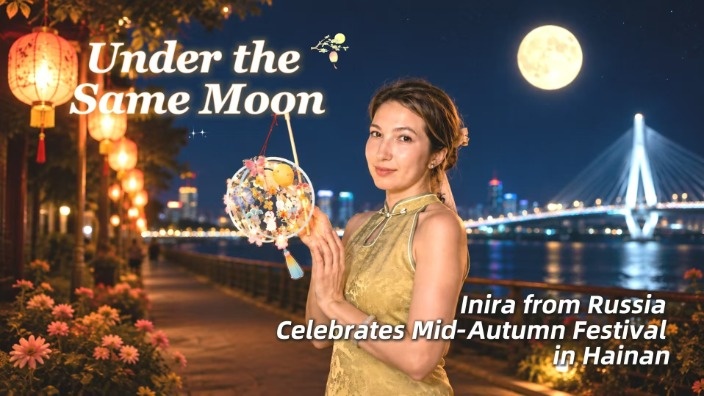
Inira from Russia Celebrates Mid-Autumn Festival in Hainan
23:41,25-September-2026

Copyright © 2021 hiHainan.All rights reserved.琼ICP备09005000号-13
 thisishainan@163.com
Partner: Hainan College of Foreign Studies