


Writer's Profile:
Eva Molaro has lived in China for nearly 20 years and has developed a deep love for Chinese culture, art, and language. Married to a Chinese designer and mother of two, she is committed to serving society by fostering an environment that benefits both the local community and her children’s future. Through storytelling, art, and meaningful exchange, Eva builds bridges between cultures, promoting understanding, collaboration, and mutual respect.
The mysteries of ancient Egypt took centre stage in Haikou as world-renowned Egyptologist Zahi Hawass brought his latest archaeological investigations to the 11th China International Exposition of Museums and Relevant Products, sharing new discoveries, ongoing research and an announcement that could put the Great Pyramid of Giza back in the global spotlight in February 2027.
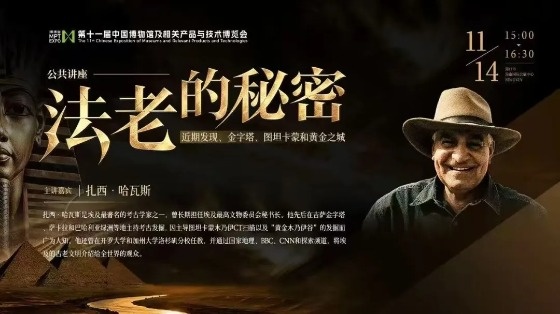
With his trademark hat, unmistakable enthusiasm and a seemingly endless supply of stories from the land of the pharaohs, Hawass certainly lived up to his reputation as a real-life Indiana Jones when he took the stage at the international museum expo.
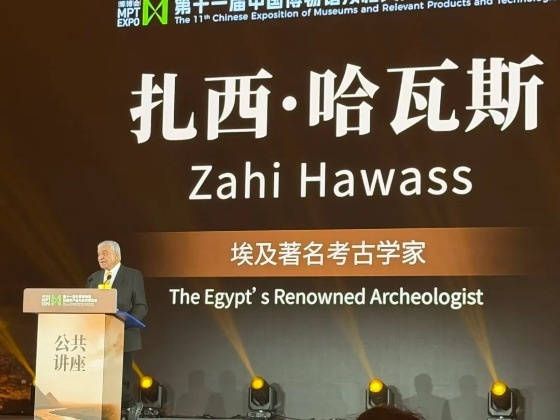
The celebrated Egyptian archaeologist, former Minister of Antiquities and one of the world's best-known faces of Egyptology captivated an audience that included some enthusiastic self-declared fans. But beyond the charisma and familiar anecdotes, his presentation offered something particularly exciting: a glimpse into the discoveries, investigations and archaeological mysteries that continue to make ancient Egypt one of the world's most fascinating fields of research.
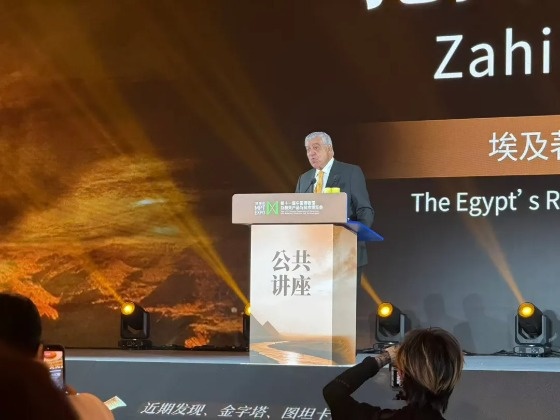
And for the Haikou audience, there was a particularly tantalising announcement to take home: February 2027 could mark a major new chapter in the investigation of the Great Pyramid of Giza.
Hawass revealed that work on the pyramid, built for Pharaoh Khufu, is expected to begin next month, with his team planning to open a door associated with a previously investigated internal structure in February 2027. The ultimate objective is to establish whether a burial chamber or tomb lies beyond it. Although the existence of Khufu's burial place within the pyramid remains an open question, the planned investigation could bring researchers closer to solving one of ancient Egypt's greatest archaeological mysteries.
The stakes could hardly be higher. Asked about the significance of such a discovery, Hawass said that if Khufu's tomb were found undisturbed, it would represent a discovery even greater than that of Tutankhamun's tomb. The comparison is remarkable, considering the worldwide sensation created by Howard Carter's discovery of the young pharaoh's burial chamber in 1922 and the extraordinary treasures it contained.
The announcement was one of several highlights of Hawass's presentation at the Haikou expo, which provided a platform for sharing archaeological research and bringing the public closer to the work taking place behind the scenes at some of Egypt's most important historical sites.
His account also covered ongoing investigations into the so-called Golden City, an ancient settlement discovered near Luxor, further tomb discoveries in the Valley of the Kings and new research at Saqqara.
Not one to shy away from controversy, Hawass also addressed conspiracy theories surrounding both his archaeological work and his public persona. The Egyptian archaeologist has long been a prominent and sometimes polarising figure, but his message was clear: archaeological discoveries should be approached through scientific investigation, evidence and the technologies available to researchers today, rather than speculation.
One of the most fascinating parts of his presentation concerned Tutankhamun. Hawass discussed the technologies employed by his team to investigate the young king's mummy, offering insights into the pharaoh's physical condition and the ongoing efforts to establish the circumstances surrounding his death. Modern scientific techniques, including advanced imaging and the examination of ancient remains, are allowing researchers to investigate questions that have fascinated generations of Egyptologists.
And Tutankhamun is far from the only mystery occupying Hawass's attention. He mentioned research projects aimed at identifying the mummy of a 12-year-old boy, further investigations into the identity and reign of Nefertiti, and research that could potentially shed new light on whether the celebrated queen also ruled Egypt as a pharaoh under another name.
At Saqqara, attention is also turning to the enigmatic Gisr el-Mudir complex and the possible identification of a pyramid associated with King Huni, traditionally regarded as the last ruler of Egypt's Third Dynasty.
Hawass also highlighted further work connected with the mortuary temple of Queen Hatshepsut at Deir el-Bahari, in Luxor. His archaeological mission has already made important discoveries in the area, including decorated limestone blocks and evidence that is helping researchers reconstruct the history of the celebrated female ruler and her monumental complex.
The presentation was not exclusively about fieldwork and scientific discoveries. Hawass also demonstrated his commitment to making Egyptology accessible to younger generations. Answering a question from an audience member about educational materials for children, he revealed that he has already published 17 children's books: seven available in other languages and another ten in Arabic. Their subjects range from Tutankhamun and the pyramids to other fascinating chapters of ancient Egyptian history.
For Hawass, archaeology is not simply about uncovering the past. It is also about inspiring younger generations, encouraging people to visit Egypt and helping them develop a lasting appreciation for its ancient civilization. In this respect, his appearance at the Haikou expo also highlighted the importance of museums and cultural institutions as gateways to history, education and international cultural exchange.
The audience was also invited to support his campaign for the return of two of Egypt's most iconic cultural treasures: the Rosetta Stone, currently housed at the British Museum in London, and the bust of Queen Nefertiti, displayed at Berlin's Neues Museum. Hawass argued that these extraordinary objects deserve to return to their country of origin.
The appeal added an international dimension to an already wide-ranging presentation, touching on the continuing debate over cultural heritage, historical ownership and the role of major museums in the twenty-first century.
For Haikou, the encounter with Hawass was a fitting highlight of an expo dedicated to museums and the preservation and presentation of cultural heritage. His appearance brought together history, science and the sheer excitement of discovery, reminding the audience that ancient Egypt is anything but a closed chapter.
Yet among all the stories, discoveries and historical mysteries shared on stage, one announcement stood out above the rest. Hawass gave the Haikou audience a date: February 2027. That is when his team plans to open the door associated with the mysterious internal structure of Khufu's Great Pyramid, potentially bringing researchers one step closer to a discovery of historic significance.
For now, the announcement leaves us all holding our breath, waiting to see what lies behind that door.
Real-life Indiana Jones wows Haikou audience with new discoveries
14:48,15-November-2026
Why This Hainan Village Clinic Sees Over 20,000 Visits a Year
20:50,14-November-2026
Philadelphia Orchestra Wraps Up Haikou Concerts
20:50,14-November-2026
Autumn Hols: China's New School Break Gives Families a Five-Day Getaway Opportunity
20:49,14-November-2026
Hainan girl's Dunhuang journey: Dunhuang Night Market · Taste of the World
17:28,13-November-2026
2026 China International Travel Mart Opens in Haikou December 12
21:10,12-November-2026

Copyright © 2021 hiHainan.All rights reserved.琼ICP备09005000号-13
 thisishainan@163.com
Partner: Hainan College of Foreign Studies