


At the inaugural World New Energy Vehicle Congress (WNEVC) in 2019, a goal was set for new energy vehicles (NEVs) to make up 50% of the global vehicle market by 2035. At the time, it was still a pipedream. Seven years later, at the 2026 WNEVC, that goal is moving closer to reality.
Data released at the main forum, “NEV50@2035: Transformation, Upgrading and Low-Carbon Development,” on the afternoon of September 22, indicated that by 2025, the global NEV market share surpassed 23%. Developing NEVs has become a common strategy for countries aiming to cut transportation emissions and promote a green transition.
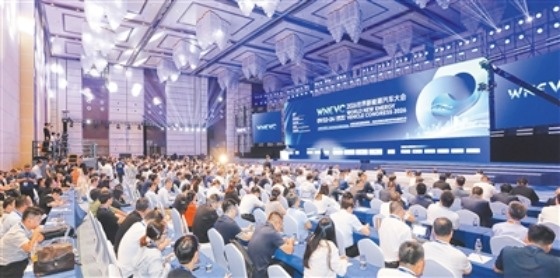
The main forum of the 2026 WNEVC “Global Development and the Hainan Free Trade Port — Electrification, Intelligent Transformation, and a Gateway for Automotive Global Expansion” is held in Haikou on September 22.
(Feng Shuo/Hainan Daily)
A more important development than the raw figures is the evolving industry consensus. Discussions at the congress highlighted that the industry is increasingly prioritizing a transition that is both sustainable and affordable. The focus is also shifting from price wars and technology competition to building green, low-carbon strengths across the entire value chain.
Low-carbon transition requires value-chain coordination
Hildegard Müller, President of the German Association of the Automotive Industry, is attending the WNEVC for the third consecutive year. She believes the global automotive industry has shifted its focus from questioning whether the transition would happen at all to determining how to achieve long-term success, sustainability, and affordability.
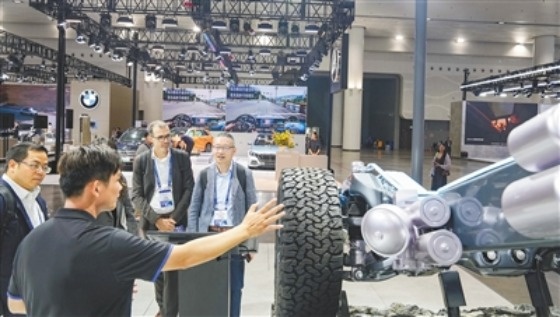
Guests take a close look at NEV technologies in the exhibition area of the 2026 WNEVC.
( Chen Yuancai/Hainan Daily)
What determines a vehicle's greenness? The issue extends past emissions during operation. It includes battery material extraction and recycling, manufacturing energy use, charging infrastructure, cross-border data exchanges, after-sales services, and end-of-life battery disposal, all of which affect the vehicle’s overall carbon footprint.
Speakers at the congress proposed advancing on three main fronts. Electrification remains the main route, with battery-electric and hybrid systems advancing in parallel to sustain expansion. Hydrogen and fuel-cell innovations are being quickly tested in targeted areas such as commercial transport, paving the way for broader use. Additionally, greater integration of smart and eco-friendly technologies, such as vehicle-to-grid (V2G) and intelligent charging, can also enhance energy efficiency.
Zhu Huarong, Chairman of China Changan Automobile Group Co., Ltd. and the World New Energy Vehicle Development Organization (WNEVDO), emphasized that global expansion requires more than a single strategy. He said a company's true strength lies not in distributing identical products everywhere, but in delivering cost-effective, eco-friendly solutions tailored to local demand.
Ralf Brandstätter, a member of Volkswagen AG's Management Board and CEO of Volkswagen Group China, said the industry is shifting from competing on innovation and speed to converting innovation into sustainable profits. As intelligent driving and AI become more accessible, faster model updates and the rapid adoption of new technologies are squeezing profit margins. He emphasized that only when innovation consistently yields stable returns will there be enough capital to invest in low-carbon technologies and meet the 2035 goal.
Hainan: focus on supply chains, after-sales, and data
Hainan has become a significant player in this transition. In 2025, NEV sales in the province reached 133,800 units, with a market share of 64.35%, the highest among China’s provincial-level regions. Between January and August 2026, the province sold 70,600 NEVs, accounting for 66.14% of all new vehicle registrations. The province now has nearly 600,000 NEVs on the roads, representing 25.74% of its total vehicle fleet.
Guo Shougang, Director-General of Department I of Equipment Industry at China’s Ministry of Industry and Information Technology, said Hainan was among China's first regions to promote NEVs and has seen encouraging results.
Hainan is advancing on three fronts — supply chains, after-sales services, and data — to shift its NEV industry from demonstration projects to full-scale industrial growth, moving from serving domestic markets to connecting with global markets.

The 2026 WNEVC features an NEV technology and science exhibition showcasing new energy vehicles
(Chen Yuancai/Hainan Daily)
Chris Mason, CEO of FISITA, emphasized that the green and intelligent transformation and sustainable growth of the global automotive sector involve contributions from multiple stakeholders. He also highlighted that Hainan has the potential to serve as a key testing ground for the industry in redesigning supply chains and expanding into emerging markets.
NEV50@2035 is not just about quickly increasing sales; it is a collaborative effort across energy, manufacturing, transportation, trade, and policy sectors. Hainan’s unique strength lies in turning pilot initiatives into scalable models, advancing vehicles from zero emissions to low-carbon standards across the entire value chain, while opening a broader gateway for the automotive industry to expand globally.
WNEVC Moves Beyond Speed to Low-Carbon Value Chain
12:44,24-September-2026
The Port of Firsts: Digital Economy Firms Go Global from Century-Old Volcanic Village in Haikou
12:12,23-September-2026
World NEV Congress Opens as Hainan Eyes Export Service Hub
12:12,23-September-2026
Hainan's Wintering Waterbirds Top 40,000 as Rare Bird Numbers Hit New Highs
17:00,22-September-2026
Haikou-Wenzhou Cargo Route Connects Southeast Asia to the Yangtze River Delta
17:00,22-September-2026
Pinglu Canal Opens, Allowing New Opportunities to Flow to Yangpu
21:56,20-September-2026

Copyright © 2021 hiHainan.All rights reserved.琼ICP备09005000号-13
 thisishainan@163.com
Partner: Hainan College of Foreign Studies