


"I never imagined that less than a year after the company was registered, we would be standing on the stage of the World AI Conference." On July 17, 2026, in Shanghai, 23-year-old Huang Xiande, a Gen Z entrepreneur, showcased his team and industrial AI product system at the 2026 World AI Conference. His company, the Hainan Degong Intelligent Technology Company, was established less than a year ago.
Four years ago, Huang was in the first cohort of international elite students taking classes at the Lingshui Li'an International Education Innovation Pilot Zone in Hainan. Now, he’s moved on from a seat in the classroom to standing on the stage of this annual global AI event. His development has flourished in the fertile ground of Lingshui Li'an, a place that supports innovation and experimentation.
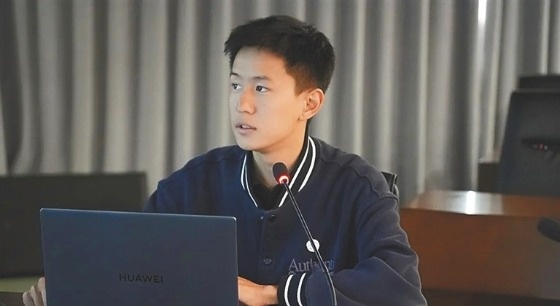
Huang Xiande. Photo courtesy of the interviewee
At the AI event, a terminal occupying no more than half a square meter of space attracted considerable attention. This is one of Degong’s core exhibition products—an AIOS all-in-one desktop computer for medical scenarios. The device consolidates the complex and scattered systems of a hospital into a single machine: doctors can use it for data retrieval, medical record processing, report interpretation, and scientific research analysis. Patients can use it for triage, pre-diagnosis, follow-up, and health management, while hospital-level model management, application development, and capacity scheduling are all also coordinated by this "super brain." This all-in-one machine is the entry point for local computing power, medical-specific small modeling, and AI application platforms, all supported by the complete medical AI application system created by Degong. "Our medical-specific small models, compared to some general-purpose large models on the market, are like the difference between a medical expert and an all-round expert," explained Huang. "They have lower computing power requirements, faster response times, are more suitable for local deployment, and are more aligned with medical question-and-answer and business processes." The all-in-one machine is responsible for local deployment, the small models are responsible for low-computing-power inference, and the AI application platform is responsible for unified development, orchestration, and governance, and is ultimately useful in the hospital's real business scenarios. This complete medical AI capability chain attracted the attention of many professionals at the conference. "Unlike AI applications that start from a single tool, we focus more on systemic problems in complex organizations," said Huang. This young, AI-native technology company focuses on complex scenarios such as healthcare, education, and smart parks, aiming to build operable, governable, and replicable industrial AI infrastructure.
Why did this startup AI company, with a team fresh out of university, choose Lingshui, Hainan, and how did it grow so rapidly? Huang's answer is straightforward: “The pilot zone opened up real-world application scenarios for us. Our product system 'grew' from the soil of the pilot zone." In 2021, Huang was still a student at the University of Electronic Science and Technology of China. The Hainan Lingshui Li'an International Education Innovation Pilot Zone—a key Sino-foreign cooperative education park in the Hainan Free Trade Port—was recruiting the first cohort of international elite students globally, including projects in cooperation with his alma mater. Moved by the prospect of ‘experiencing international education while studying in Hainan’, Huang decided to enroll, becoming one of the first students in the pilot zone. During his time at university, he won first prize in the Hainan Free Trade Port Future Elite Innovation and Entrepreneurship Competition and met like-minded business partners, planting the seeds of entrepreneurship. After graduation, he and his team traveled to cities like Beijing and Shanghai, but repeatedly encountered setbacks, almost always for the same reason: they were a student team, they were too young, and they were too inexperienced. Just when they were about to give up, the pilot zone called, saying that the park had a new development environment and inviting them to come back and take a look. "What really touched me was the pilot zone's attitude. The management staff contacted me immediately to understand my needs and proactively offered to open up real-world application scenarios within the park," Huang recalled. That was the opportunity they had been longing for—a valuable resource that allowed their research results to exit the laboratory and enter the wider world.
In September 2025, the Hainan Degong Intelligent Technology Company was registered. The pilot zone specially formed a service team to provide support throughout the process, assisting with everything from business model analysis to resource matching. At the same time, the pilot zone's innovation funding support—"invest first, then convert to equity"—provided the young team with a much-needed start-up guarantee. With this confidence, Huang and his team devoted themselves to research and development. Their first product was an intelligent document generation system based on a campus scenario, starting with office efficiency and gradually expanding to other applications. Today, the "Li'an Shu" smart park operating system has already been implemented in the pilot zone. This system combines park governance, government affairs processing, and student and faculty services, eliminating information silos and becoming a benchmark case for Degong.
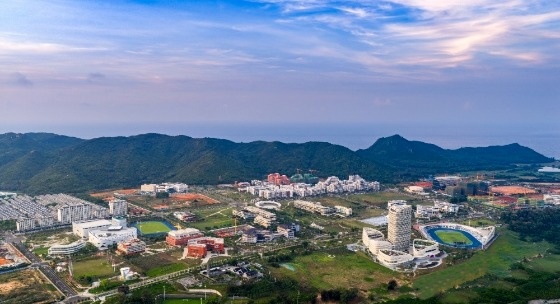
The Hainan Lingshui Li'an International Education Innovation Pilot Zone. Photo provided by the Pilot Zone Administration
Degong continues to expand into new areas. Last November, the Lingshui Li Autonomous County Digital Investment Company signed a strategic cooperation agreement with Degong to jointly explore new paths for the digital upgrade of urban governance. Huang believes that "scientific research results and products can only truly take root and flourish in industries and scenarios when combined with industry experience." Rooted in Lingshui, Huang feels the strong vitality of the area. "Lingshui is a good place for young people to start businesses. Lingshui is open not only in concept. It provides tangible support such as resource coordination and mechanism innovation." He described the relationship between Degong and Lingshui as a win-win relationship: "We serve local development through technology, and the local government supports business development through scenarios and ecosystems - it's mutually reinforcing."
Over the past four years, Huang has transformed from a student to a participant in the development of the pilot zone. Looking ahead to the next four years, he’s even more determined to unleash the greater value of AI technology in a wide variety of fields such as healthcare, government affairs, and education, leading to greater achievements in Lingshui. He looks forward to leveraging his excellent start in Lingshui to ascend to a larger global stage.

Hainan Through Culture: Major Heat
14:41,24-July-2026
Degong: From Lingshui to the World AI Conference Stage
14:18,24-July-2026
Beachcomb Responsibly. Protect Hainan's blue sea and golden shore.
14:40,23-July-2026
Haikou Bay Night: Hawaii Youth's First Glow
17:32,22-July-2026
Journey Across a Century with Savina| Wuzhishan
11:13,22-July-2026
Journey Across a Century with Savina| Lingshui
11:13,22-July-2026

Copyright © 2021 hiHainan.All rights reserved.琼ICP备09005000号-13
 thisishainan@163.com
Partner: Hainan College of Foreign Studies