


At 7:30 a.m., Jing Liwei rides his e-bike to the cafeteria. A year ago, this freshman from Sichuan, China, was busy selecting "Digital Media Technology" on his Gaokao application form. Today, he can walk to the ocean in under ten minutes, studying on a campus without barriers where he pursues degrees from both China and the UK.
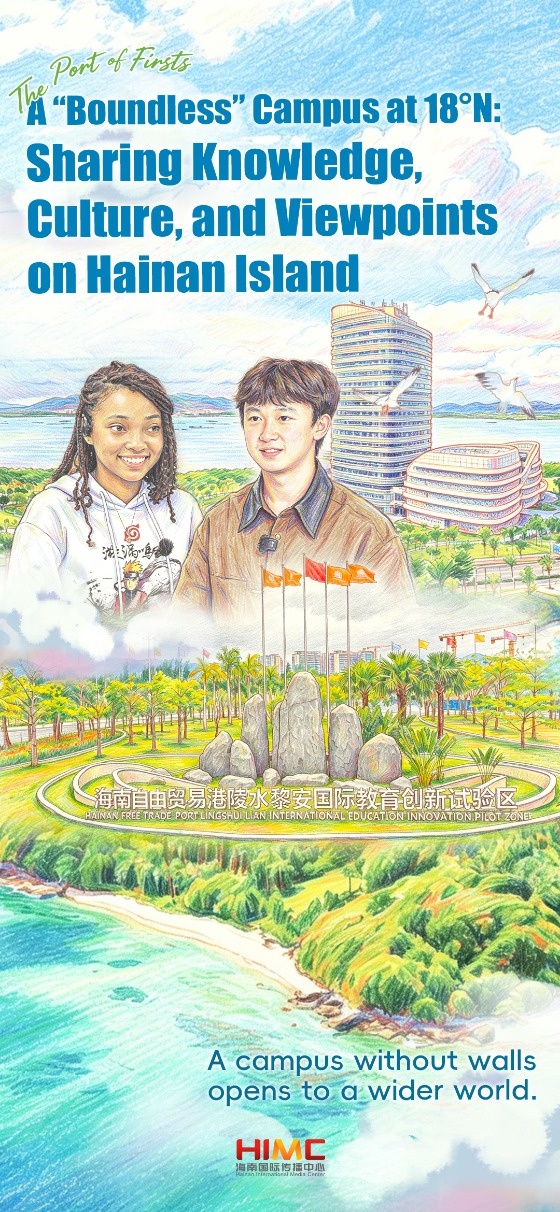
"As a child, the beach was just a place to visit. Now, it defines the contours of my life here," says Jing. He attends the Queen Mary School of Hainan, Beijing University of Posts and Telecommunications—one of numerous Sino-foreign cooperative institutions within the Hainan Free Trade Port's Lingshui Li'an International Education Innovation Pilot Zone that offer dual-track degree courses. But for him, the biggest draw isn't the "dual-degree" label. It's the shared-course system that allows him to take classes across different universities.
"BUPT is a science and engineering school, so I always worried I'd miss out on the humanities and social sciences," Jing explains. "But here, I can take courses offered by Beijing Language and Culture University or Minzu University of China. It's a great feature that fills the gaps in my interests."
Jing’s favorite course isn't even a core requirement—it's a fully English-taught class called Technical Language and Academic Study Skills. "At first, memorizing and understanding purely English terminology was tough. But after a few weeks, once I got the hang of it, everything clicked," he recalls. "This course helped me understand the logic of English academic thinking, which will be really useful for writing papers in the future."
Meanwhile, at the Hainan College of Beijing Language and Culture University—another institution within the zone—Ticia, a freshman from Madagascar, sits in the library café chatting with fellow students. What attracted her to Lingshui wasn’t its vibrant academic community, but its rustic, backwater environs.
"I grew up in the countryside. I'm a quiet person. Big cities are too noisy; here, I can actually reflect," she says. "Lingshui has quiet beaches and romantic sunsets. More importantly, it feels like home."
By "home," she means the sense of belonging that comes from the zone’s international makeup. "In other places, you really feel like a minority. But here, you can meet people from different countries at any time in the library. When I'm tired, I come over for a coffee and a chat—recharge my batteries—and then I go back to studying."
Two months ago, the zone hosted a World Culture Festival. Ticia and her friends took the stage to perform an African dance. "When the music started, I thought: This is my moment. It's time to shine," she says with a smile. "We were dancing styles from different African countries—not just to show off, but to help more people discover the beauty of our culture. After the performance, an Indonesian girl told me she loved African dance, and a few Chinese girls said they wanted to learn with me. Dance, music, food—these small things can bring people from all over the world together. I find that very inspiring."
Although Jing didn't take the stage, he too appreciates the melting pot that is the zone, describing it as tongda—accessible and open. "Physically, I can go anywhere and use any facility without barriers. Mentally, exchanging ideas with classmates from different schools and nationalities gives me a deeper understanding of different cultures," he says. "The zone isn't large, but the connections between schools create a big community—interconnected and interlinked. This sense of familiarity makes me more composed and confident in facing my studies and life."
Ticia's future is tightly bound to this island. "I hope to find a job in international trade between Hainan and Madagascar, becoming a bridge that connects the two," she says. "Hainan is opening up to the world. I want to contribute to that openness and seize the opportunities it offers young people globally."
This international education pilot zone, located in Lingshui's Li'an Town, is the Hainan Free Trade Port's only key park dedicated to educational openness. Currently, the zone—nestled amid the waves—is home to students from over 50 countries and regions, with a total campus population exceeding 10,000. Twenty-four Sino-foreign cooperative institutions and programs, 337 shared courses, and 7,000 cross-university enrollments underpin the "Big Sharing + Small Colleges" model. But for Jing and Ticia, these nuts and bolts are just background noise. One wants to deepen his expertise in digital media while broadening his humanistic horizons; the other wants to become a bridge for China-Madagascar trade, finding her rhythm by the quiet sea.
Once a university tears down its physical walls, the boundaries left for its students to dismantle are those of the mind.
Executive Producer: Shang Lin
Chief Producer: Niu Xiaomin
Creative Producer: Zhou Yuan
Producers: Chen Shuhuan, Wang Jingxuan
Production Coordinator / Written By: Chen Xiaodan
Video Editor: Zhou Chenguang
Cameraman: Ma Yiming
Visual Effects: Yan Lechi
Translator/Proofreader: David Janke (UK)
Designers: Liang Yuzheng, Yan Lechi
Voiceover:Iain Inglis
Copy Editors: Chen Xiaodan, Shang Yingxi
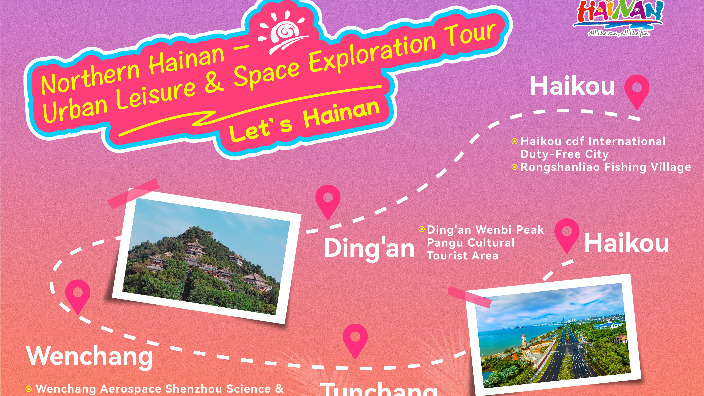
Wushu Taolu World Cup For International Visitors Explore Hainan along 6 Themed Routes
17:56,12-June-2026
Hong Kong Media Influencers Experience the "Slow" and "Fast" Beats of the Hainan FTP
18:26,11-June-2026
A Small Thai Shop Brings South Seas Culture to Hainan
18:26,11-June-2026
The Port of Firsts | A “Boundless” Campus at 18°N: Sharing Knowledge, Culture, and Viewpoints on Hainan Island
16:43,10-June-2026
ENJOY AI 2026 Asia Championship to be held in Haikou in August
16:34,09-June-2026
Hainan-Based Female Scientist Featured in This Year's Gaokao Chinese Paper
16:34,09-June-2026

Copyright © 2021 hiHainan.All rights reserved.琼ICP备09005000号-13
 thisishainan@163.com
Partner: Hainan College of Foreign Studies