


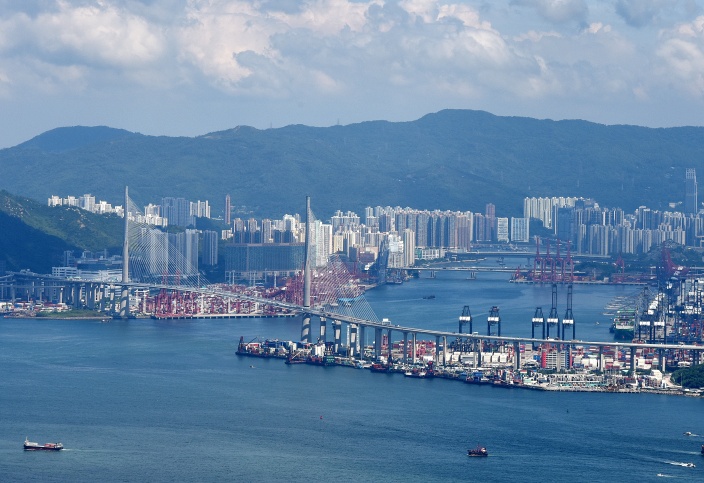
Hongkong International Terminals
Some have asked how the development of China’s southern island province of Hainan as a free trade port (FTP) might impact the Hong Kong Special Administrative Region. Some critics, intentionally or unintentionally, have misled public opinion, describing the Hainan FTP as a tactic aimed at diminishing Hong Kong's economic standing. In fact, it creates new opportunities for growth and development, from which Hong Kong, in particular, is well-positioned to benefit.
Broader Historical Contexts
To start, we need a bit of historical context to provide us with sharper perspectives. Let’s recall that Hong Kong is part of China under the rubric of “one country, two systems.” Even before reunification in 1997, given its unique characteristics as a long-established global financial hub, Hong Kong played a vital role in the Chinese economy, and vice versa. This positive relationship has deepened considerably over the past 29 years, especially in the new era, given increasing regional integration and cooperation in the Greater Bay Area (GBA).
As China opened up and developed, a process that began in 1978 and accelerated in the 1980s, working-class and middle-income Hong Kongers could visit the Chinese mainland to take advantage of lower-priced products and services in ways that improved their standards of living. These advantages were especially apparent when the Chinese mainland’s development levels were lower than they are now, but in fact, many Hong Kong working-class and middle-income residents to this day regularly cross into Shenzhen or other parts of the Chinese mainland to enjoy improved access and better prices related to normal consumption needs, particularly in medical care. It’s also the case that Chinese mainland residents have also had the ability and financial means to visit Hong Kong, and while this has been a boon for the property market and enriched those selling to Chinese mainlanders the products they seek, it has inevitably put some pressure on more economically vulnerable populations that experienced higher prices.
That said, data from the IMF, the World Bank, and the Hong Kong Census and Statistics Department illustrate that inflation rates in Hong Kong over the past three decades have been relatively moderate and have not outpaced global averages. There have been short-term ups and downs, given deflationary pressures associated with the Asian Financial Crisis, starting in 1997, and again during the pandemic. In fact, inflation was a serious concern in Hong Kong in the 1990s, due to property and consumption booms poorly managed by the British colonial government, which not only created greater inequality but also made Hong Kong more vulnerable to the crisis that arrived in 1997.
As Hong Kong reeled from that crisis, sparked by Western currency speculators and hammering many Asian economies, it was the Chinese mainland that provided Hong Kong with critical support, including measures that maintained the stability of the Hong Kong dollar and ensured the smooth operation of financial markets. These included policies that provided financial support, coordinated policy, and strengthened trade cooperation, ensuring economic and social stability. The total value of these supports have never been made publicly available—a practice echoed in the US given the extraordinary but publicly unaccounted market interventions made in the wake of the Global Financial Crisis in 2008—but experts believe the supports were both substantial and instrumental in helping Hong Kong weather a financial storm that left other Asian economies dispossessed and subject to increasing political instability, including Indonesia, Thailand and South Korea.
Hong Kong Port Operations
Some critics of the development of the Hainan FTP focus specifically on potential impacts on the Port of Hong Kong. In fact, Hong Kong has consistently maintained its status as a major global shipping hub.
In the early 2000s, it was the world’s busiest container port, handling over 20 million TEUs (twenty-foot equivalent units) annually. In the 2010s, throughput remained strong, but competition from rising ports from the Chinese mainland, including Shenzhen and Shanghai, increased. Nevertheless, annual figures ranged between 20 and 24 million TEUs. In the 2020s, throughput has fluctuated downward due to global economic conditions influenced by the pandemic, US trade aggression, and supply chain adjustments. In 2023, Hong Kong handled approximately 14.4 million TEUs, and in 2024, this number fell to 13.7 million. Complete data for 2025 is not yet available, but through the third quarter, it was down 4.9% compared to the previous year.
Some believe Hong Kong’s port contraction is primarily attributable to the development of the Chinese mainland ports, but such views miss several key points. First, the real cause of the contraction has more to do with external pressures than with those from Chinese mainland operations, which were further amplified by challenges unique to the Hong Kong port specifically. Second, it ought to be clear that in the 2010s, before global headwinds and before the US began targeting China especially, the Chinese mainland and Hong Kong economies benefited from increased throughput capacity, contributing to tremendous economic growth and development that benefited Hong Kongers and Chinese mainlanders alike. Third, the development of port operations on the Chinese mainland significantly lowered shipping costs, making Chinese products more competitive and the Chinese market more attractive. It also more evenly distributed wealth and development and ensured China was not dependent on a single port, which would create a strategic vulnerability given the increasing extreme weather associated with climate change and the intensifying great power competition.
On the one hand, Hong Kong remains vital for global shipping, especially for high-value, time-sensitive cargo, while Hainan is better suited for regional shipping. On the other hand, Hong Kong is directly in the path of intensifying typhoons and has limited space to substantially upgrade resilience measures to protect cranes and stacked containers. Meanwhile, Hainan’s ports are more protected given their placement on the western side of the island facing into the Beibu Gulf, and they also have ample space to build buffers to counter wind and surge.
Here, it’s important to remember that Hong Kong is one of the most densely populated places in the world, with more than 7 million people inhabiting 1,106 square kilometers, a very significant portion of which is considered uninhabitable or restricted from development due to topographical, environmental, and planning reasons, conditions that contribute to high property prices. According to 2023–2024 data, the average property price in Hong Kong was approximately HKD 130,000-160,000 per square meter. Conversely, Hainan is home to approximately 11 million people but on an island with a land area of approximately 35,400 square kilometers, e.g., roughly equivalent to the size of China’s Taiwan Island or the Kingdom of Belgium. Meanwhile, average property prices in Sanya, which are significantly higher than all other parts of the island, including Haikou, are roughly a third of Hong Kong’s, while those areas surrounding Hainan’s ports are a mere fraction.
The Hong Kong SAR and central governments have been taking measures to enhance Hong Kong’s port competitiveness and security, including promoting the development of high-value-added maritime services, strengthening regional cooperation, particularly with ports in the Greater Bay Area, and optimizing port operations and logistics processes. Significant infrastructure investments over the past decade include: the Kai Tak Cruise Terminal (operational since 2013) and associated enhancements; automation and technology upgrades at container terminals (e.g., automated gate systems, crane upgrades); berth deepening and yard reconfigurations to handle larger vessels; investment in logistics and port back-up areas, including the development of the Hong Kong-Zhuhai-Macau Bridge connectivity; and green port initiatives (e.g., shore power facilities, LNG bunkering pilots). While Hong Kong Port is technologically advanced and retains its own strengths, ports on the Chinese mainland have established new gold standards in port technology that Hong Kong can emulate, especially with governmental support.
Benefitting Each Other
It ought to be clear that Hong Kong’s return to China has not only advanced sovereignty and security and resolved a historical wrong that originated with imperialist gunboat diplomacy, but this return has been critical for helping Hong Kong respond to economic crises and other threats, and likewise move forward in a fast changing world that requires significant adaptations, including increased regional and national cooperation. It can be argued that, among regional integration projects worldwide, the GBA is increasingly recognized as among the best, if not the best. These efforts continue to advance, and Hong Kong has already benefited tremendously. Hainan is being drawn into this paradigm through the establishment of its FTP operations, and the benefits will continue to accrue to Hong Kong and the region as a whole.
Meanwhile, the “one country, two systems” framework ensures Hong Kong’s unique advantages in connectivity with global markets, allowing it to act as a bridge for foreign investment into Hainan while reinforcing its own status as an irreplaceable international financial center—and do so in an era of growing risks associated with currency, trade wars and unipolar attacks on the global financial system. Altogether, we can expect growing links between Hong Kong and Hainan to produce synergies that reinforce the Hong Kong dollar and contribute to the internationalization of the yuan, the Chinese mainland’s currency. With this in mind, we can note that Hong Kong will remain more liberalized in capital flows and legal familiarity for global businesses, whereas Hainan offers broader experimental policies in sectoral access and tax incentives under China's sovereign framework.
As previously noted, there are incredible opportunities for Hong Kong’s port-related services to expand their market in Hainan, especially as they face pressure from the US to withdraw from the Western Hemisphere. At the same time, Hainan has new open policies that provide growth opportunities for Hong Kong’s globally competitive healthcare and education industries. Indeed, many Hong Kong enterprises will gain a competitive advantage by expanding their operations into Hainan.
Also, as noted previously, Hong Kong Port will continue to focus on high-value and time-sensitive cargo, above all because it has mature relationships around the world that convey trust and facilitate speed, but we should not be surprised if the throughput figures continue to contract as the nation emphasizes high-quality development over the old industrial models that focused on quantity. That said, Hainan will be more devoted to opening the Chinese mainland market, helping drive domestic consumption and efforts to move up the value chain, consistent with national efforts to accelerate what globalists call the fourth industrial revolution.
Altogether, with these points in mind and the right historical perspectives, we can see how Hainan and Hong Kong can grow together, given their respective strengths and capacities for cooperation, exemplifying the “one-country, two-systems” policy.
Josef Gregory Mahoney is a professor of politics and international relations and director of the Center for Ecological Civilization at East China Normal University in Shanghai. He is also a senior research fellow with the Institute for the Development of Socialism with Chinese Characteristics at Southeast University in Nanjing. The views do not necessarily reflect those of Hainan International Media Center.
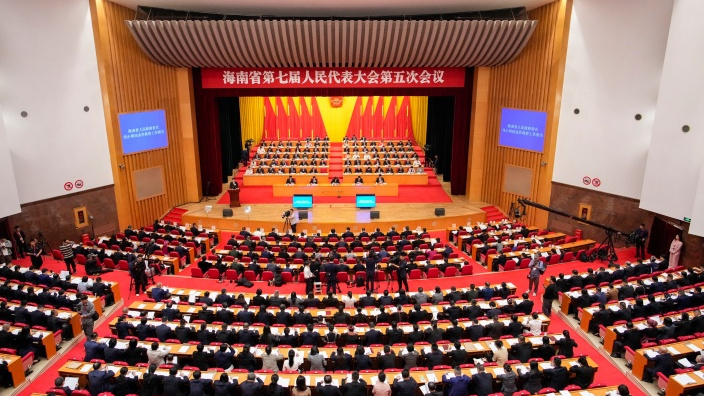
Hainan will strive to raise average life expectancy to 81.2 years
20:08,27-January-2026
Hong Kong and Hainan can Grow Together
20:08,27-January-2026
Hainan aims to increase the number of foreigners working in Hainan by 20%
18:49,27-January-2026
Hainan to strive to obtain approval for one new independently operated institution run by an overseas university
18:19,27-January-2026
Hainan to achieve near-universal continuation of education for junior high graduates, with 70% entering general academic high schools
18:17,27-January-2026
Hainan has set a GDP growth target of around 6% for 2026
16:38,27-January-2026

Copyright © 2021 hiHainan.All rights reserved.琼ICP备09005000号-13
 thisishainan@163.com
Partner: Hainan College of Foreign Studies