



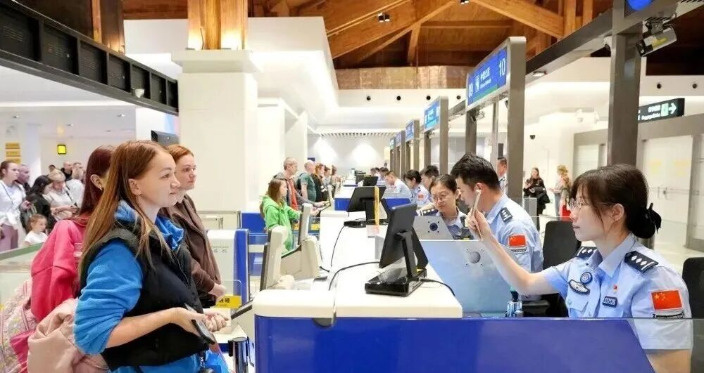
Haikou, the capital city of Hainan Province.
As China accelerates the development of the Hainan Free Trade Port, a familiar claim has resurfaced in both domestic and international commentary: that Beijing intends for Hainan to replace Hong Kong. The argument sounds intuitive. Yet intuition, in this case, is precisely the problem.
The idea of "replacement" has gained traction not because it reflects China's policy design, but because it fits a convenient narrative. When examined more closely—at the levels of policy intent, institutional capacity, and structural logic—the proposition collapses. Hainan was not designed to replace Hong Kong, nor could it realistically do so.
How the "replacement" narrative took shape
Within China, the replacement claim is largely the product of a simple temporal coincidence. Hong Kong has undergone significant changes in recent years, while Hainan has been elevated as a high-profile national opening-up project. Observed side by side, these developments invite a straightforward—but misleading—inference: as one gateway faces uncertainty, the state must be preparing another to take its place.
This is a classic case of mistaking simultaneity for causality. The conclusion does not arise from ideology or confrontation, but rather from an intuitive, linear approach to reading policy timing. Once introduced, the notion of "replacement" gains momentum because it is easily communicated. Compared with other plausible concepts such as functional differentiation or multi-node openness, it is sharper, more dramatic, and far more discussable.
Internationally, the logic is different but no less flawed. In much Western commentary, China's institutional initiatives are often interpreted through the lens of "strategic substitution": if an existing interface becomes politically complicated, Beijing must be building a controllable alternative. Under this assumption, Hong Kong is framed as an increasingly constrained international node, while Hainan is imagined as a centrally managed successor-in-waiting.
In some cases, the replacement narrative goes further, serving as a divisive wedge. By repeatedly suggesting that Hong Kong's role is being downgraded or transferred, national-level spatial planning is recast as a zero-sum contest between the central government and the autonomously administered city. The purpose is not to understand policy design, but to introduce doubt—about trust, status, and long-term intent.
Why replacement was never the policy objective
Once the discussion moves from narrative to policy analysis, the replacement claim fails on three fundamental grounds.
First, there is no strategic incentive.
Hong Kong remains one of China's most valuable institutional assets. Its common law system, international financial credibility, and dense professional networks have been validated by global markets over decades. From a governance perspective, deliberately weakening such an asset would raise costs and risks rather than reduce them. Unsurprisingly, Chinese policy documents and official statements consistently emphasize complementarity and differentiated roles—not substitution.
Second, Hainan lacks the capacity to replace Hong Kong.
The two are not institutionally comparable. Hong Kong's legal system, arbitration functions, and judicial autonomy cannot be replicated through policy engineering. Hainan, operating within a civil law framework, is designed as a site for institutional innovation, not as a like-for-like alternative. Financial ecosystems rooted in trust, habit, and informal networks do not emerge on command.
Third, the two serve different functions within different risk structures.
Hainan is best understood as a high–error-tolerance zone for institutional experimentation. Hong Kong, by contrast, is a mature node whose primary value lies in stability and predictability. One absorbs policy risk; the other minimizes it. These roles are not interchangeable, nor are they intended to be.
At a deeper level, the replacement narrative rests on an outdated assumption: that China must operate through a single external gateway. In reality, China's opening-up strategy is evolving toward a multi-node structure. Hong Kong, Shanghai, Shenzhen, and Hainan are embedded in the global system in different ways, performing different functions. New nodes are intended to enhance systemic resilience, not to replace existing ones.
A misleading statement
"Hainan replacing Hong Kong" is not a policy plan that has been announced, debated, or codified. It is a statement concocted beyond the realms of China's actual policy logic, shaped by narrative convenience rather than institutional analysis.
What ultimately needs to be reconsidered is not whether replacement will happen, but why it is so often assumed to be the default outcome. The persistence of the claim reveals more about the limitations of binary, zero-sum thinking when applied to a system that is becoming increasingly complex, rather than more linear.
Understanding China's opening-up today requires moving beyond the language of replacement, and toward the logic of differentiation.
Bi Yantao is a professor at the School of International Communication and Art, Hainan University, Editor-in-Chief of Communication Without Borders (Hong Kong) and Senior Research Fellow at the Charhar Institute.
Hainan Inbound Tourism Gets Off to a Flying Start in 2026
22:49,07-January-2026
Travelers Explore Hainan via Direct SE Asia Flights
22:50,07-January-2026
Meilan Airport Passenger Numbers Surge Past 26 Million in 2025
22:51,07-January-2026
A Conversation with Gen-Z Sailor Zhou Mingjing on Passion and Horizons
18:32,04-January-2026
Is Hainan Really Meant to Replace Hong Kong? A Policy Proposition That Does Not Exist
15:08,03-January-2026
Tickets for ITTF-ATTU Asian Cup to Go on Sale Jan 6
15:08,03-January-2026

Copyright © 2021 hiHainan.All rights reserved.琼ICP备09005000号-13
 thisishainan@163.com
Partner: Hainan College of Foreign Studies