


In February 2025, in an arbitration hearing room in Danzhou-Yangpu, Hainan, a commercial dispute originally scheduled to be heard in Singapore was brought to the Hainan Free Trade Port (FTP) after the parties reached a new agreement. The case was heard under Hainan’s ad hoc arbitration rules and concluded in just over three months.
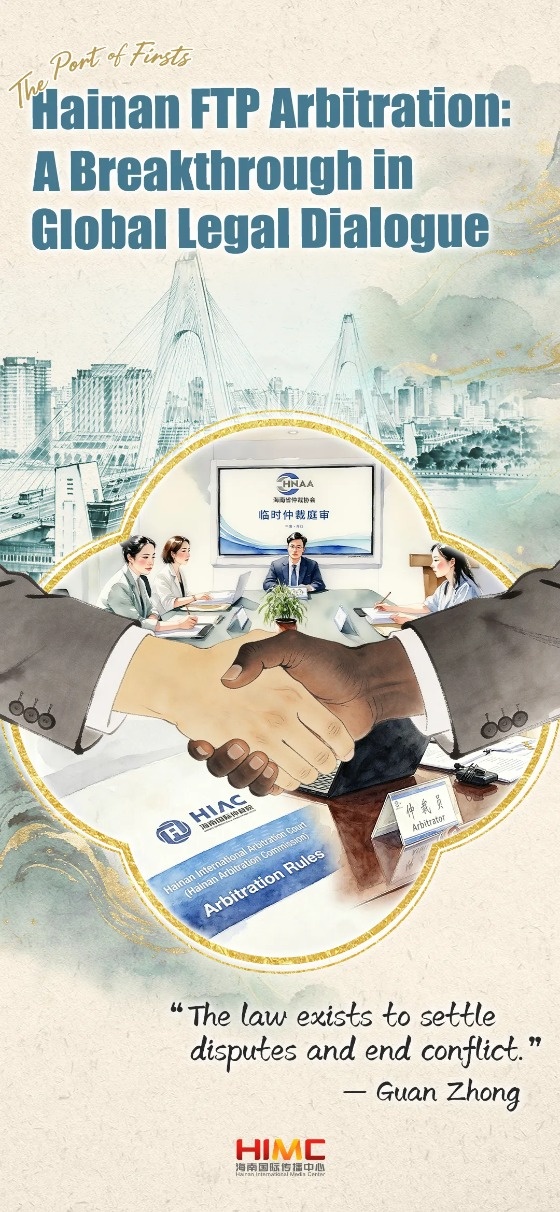
In May of the same year, the High Court of Malaysia formally recognized and enforced an arbitral award issued by the Hainan International Arbitration Court (HIAC). In the dispute, which arose from an international contract for the sale of goods, the Malaysian respondent was required to fulfill its payment obligations to the Chinese claimant in accordance with the award.
Two cities, two arbitration outcomes, and one increasingly clear trajectory: commercial arbitration in the Hainan FTP is breaking new ground.
In Hainan, ad hoc arbitration and institutional arbitration are advancing side by side, serving as two complementary pillars that enable the FTP to engage with the world through the rule of law.
Tailor-Made Ad Hoc Arbitration under the FTP Framework
Ad hoc arbitration is a widely used method of resolving commercial disputes internationally. It allows parties to select arbitrators, agree on applicable rules and decide the place of arbitration, offering a high degree of flexibility and autonomy.
On the Chinese mainland, the institutionalization of ad hoc arbitration has become a new frontier of legal reform in recent years. The country’s FTZs and the Hainan FTP have taken on a pioneering role in exploring such mechanisms in commercial dispute resolution.
Behind Hainan’s breakthrough is the Several Provisions on the Development of International Commercial Arbitration in Hainan Free Trade Port, issued in May 2024 and implemented in July of the same year.
“The significance of the Provisions lies in the fact that Hainan has exercised its legislative power as an ftp to introduce the internationally practiced ad hoc arbitration system and establish its legal status,” said Liu Daojun, President of the Hainan Arbitration Association (HNAA), in an interview.
What makes Hainan’s ad hoc arbitration model distinctive is that it is not limited to foreign-related commercial disputes. Disputes between market entities in the FTP may also be resolved through this mechanism.
To support its implementation, the HNAA has drawn on the United Nations Commission on International Trade Law (UNCITRAL) Arbitration Rules and taken Hainan’s local conditions into account in formulating ad hoc arbitration rules, expedited arbitration rules, and supporting model documents tailored for the Hainan FTP.
The Association has also selected and released two lists of recommended ad hoc arbitrators, totaling 120 members. About 20 percent of them are from outside the Chinese mainland. Hearings may be conducted in multiple languages, including Chinese, English, French, Russian and Malay.
“After assisting with the constitution of the tribunal and providing hearing venues, we step back and allow the arbitral tribunal to manage the case,” Liu said, describing the role and boundaries of the Association as a self-regulatory industry organization. “We do not interfere, but we are always ready to provide support when needed.”
Ad hoc arbitration offers parties a tailor-made solution, whereas institutional arbitration provides full-process case management by a professional institution. In Hainan, that role is primarily performed by the HIAC.
Institutional Arbitration Advances through International and Professional Reform
Since 2020, the HIAC has carried out sustained, in-depth reforms across six areas: its decision-making body, arbitration rules, arbitrator panel, governance structure, mediation mechanism, and enforcement agencies.
The scale of reform is evident in the numbers. Sixty percent of HIAC’s board members are from outside the Chinese mainland, including senior legal professionals from Hong Kong, Singapore, the United Kingdom, and other jurisdictions. Among its more than 1,200 arbitrators, about one-third are from outside the Chinese mainland, covering around 40 countries and regions. Its roster of more than 400 mediators also includes nearly one-third from outside the Chinese mainland.
The Court has been headed by Alex Fan Hoi Kit, a legal expert from Hong Kong, since 2020. His appointment marked the first time that one of the more than 200 arbitration institutions in the Chinese mainland had appointed someone from outside the mainland as head of its executive body.
The case in Malaysia in May 2025 became a touchstone for these reforms. After a dispute arose between a Malaysian company and a Chinese company, the parties turned to the HIAC. The case was heard in English by a sole arbitrator from Malaysia. The resulting award was later recognized and enforced by the High Court of Malaysia under the Convention on the Recognition and Enforcement of Foreign Arbitral Awards, commonly known as the New York Convention.
“From the inclusion of an arbitration clause in the contract, to the emergence of the dispute, the rendering of the award and its cross-border enforcement, this case reflects the full life cycle of international commercial arbitration,” Fan said. He described the case as a “milestone” in the development of arbitration in Hainan.
The case showed that awards rendered by the HIAC are indeed recognized and enforced internationally.
Hainan's international engagement in the area continues to expand. In September 2024, the Court signed a cooperation agreement with the Chartered Institute of Arbitrators (CIArb), further broadening its international network for arbitration training and certification. In December 2025, during the inaugural London Arbitration Week, it hosted a seminar that attracted more than 140 legal professionals from the United Kingdom, Europe and China.
Hainan is also making fuller use of Hong Kong’s strengths as a common-law jurisdiction and an international arbitration hub, supported by a Hainan-Hong Kong cooperation memorandum signed at the Boao Forum for Asia.
“We use Hong Kong’s strengths to serve Hainan’s needs,” Fan said.
Two Pillars for Building an International Commercial Arbitration Center
Ad hoc arbitration and institutional arbitration have become complementary pillars in Hainan’s effort to build an international commercial arbitration center.
Backed by improving regulations, increasingly open policies, and arbitration rules aligned with international practice, Hainan’s arbitration services have grown significantly in capacity. The island province is shifting from an available choice to a preferred destination for arbitration, offering efficient and professional dispute resolution services to parties from China and abroad.
As an ancient Chinese saying puts it, “The law exists to settle disputes and end conflict.” More than two thousand years later, institutional innovation is breathing new life into this idea in the Hainan FTP.

Taiwan Journalists Find a Taste of Home in Hainan's Tropical Fruit Wonderland
18:48,21-July-2026
From Hawaii to Hainan with Love
18:48,21-July-2026
Chinese Film My Ma'an Ling Expands Morocco Screening Tour to Universities and Overseas Project Sites of Chinese SOEs
13:28,21-July-2026
The Port of Firsts | Hainan FTP Arbitration: A Breakthrough in Global Legal Dialogue
19:47,20-July-2026
No trip to Hainan is complete without visiting Wuzhi Mountain
11:54,17-July-2026
Goods from African Nations Enjoy Zero-Tariff Entry to Hainan Under China's Expanded Tariff Exemption Policy
11:54,17-July-2026

Copyright © 2021 hiHainan.All rights reserved.琼ICP备09005000号-13
 thisishainan@163.com
Partner: Hainan College of Foreign Studies