


Yangpu Port in Hainan and the Port of Hong Kong recently became partner ports.
Yangpu is the main port of the Hainan Free Trade Port (FTP), while the Hong Kong Special Administrative Region (SAR) is an international maritime center under “One Country, Two Systems.”
How can the two ports strengthen the New International Land-Sea Trade Corridor, support China’s opening up to the Global South, and reshape regional shipping?
Why the two ports are a natural fit
In September 2026, the Hong Kong SAR released its first five-year plan, the First Five-Year Plan for Economic and Social Development of the Hong Kong Special Administrative Region (2026–2030). The plan specifically calls for cooperation with Yangpu, Hainan.
Yangpu Port shows what Hainan’s free trade port policies can achieve. In 2025, it handled 3.31 million twenty-foot equivalent units (TEUs), up 65% year on year, as the benefits of those policies began to show.
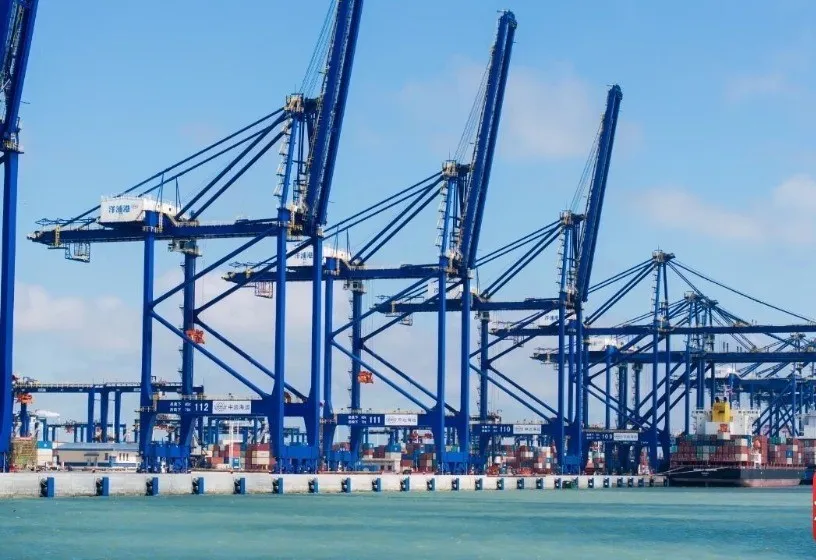
Yangpu Port.
Yangpu is the closest deepwater port to major international shipping routes that snake through the Beibu Gulf. It also sits at the intersection of the New International Land-Sea Trade Corridor and the 21st Century Maritime Silk Road. Yangpu International Container Terminal has 1,970 meters of operational quayside and a design capacity of 5 million TEUs a year. The port has launched 68 container liner routes, serving domestic and international trade on both short- and long-haul routes.
Hong Kong, a major international maritime center, handled around 13 million TEUs in 2025. Container ships spent an average of just 1.03 days in port, well below the 1.99-day average at the world’s 20 largest container ports. That quick turnaround helps vessels make up time lost elsewhere.
Hong Kong SAR Chief Executive John Lee has stated that international maritime industry is undergoing unprecedented change. As geopolitics shift and supply chains are reshaped, he said, the industry needs certainty and strategic coordination more than ever.
From partnership to practical cooperation
In November, the Department of Transport of Hainan Province, the Administrative Committee of the Yangpu Economic Development Zone, and the Hong Kong SAR Government’s Transport and Logistics Bureau signed a memorandum of understanding.
The three parties will hold regular consultations. They will coordinate which ports serve export cargo, make better use of their complementary shipping routes, explore fast-track shipping arrangements, and organize exchanges for maritime professionals.
Mable Chan, Hong Kong’s Secretary for Transport and Logistics, said in an interview that the partnership would extend beyond adding shipping routes. She highlighted Hong Kong’s high-end maritime services, including arbitration, insurance, legal services, and ship management, as ways to support Hainan’s contribution to building China into a maritime powerhouse.
Hong Kong’s Port Community System tracks cargo in real time, 24 hours a day. It combines sea, land, and air transport data so that logistics operators can share information and move goods more easily. The system also supports supply chain digitalization and the development of smart ports.
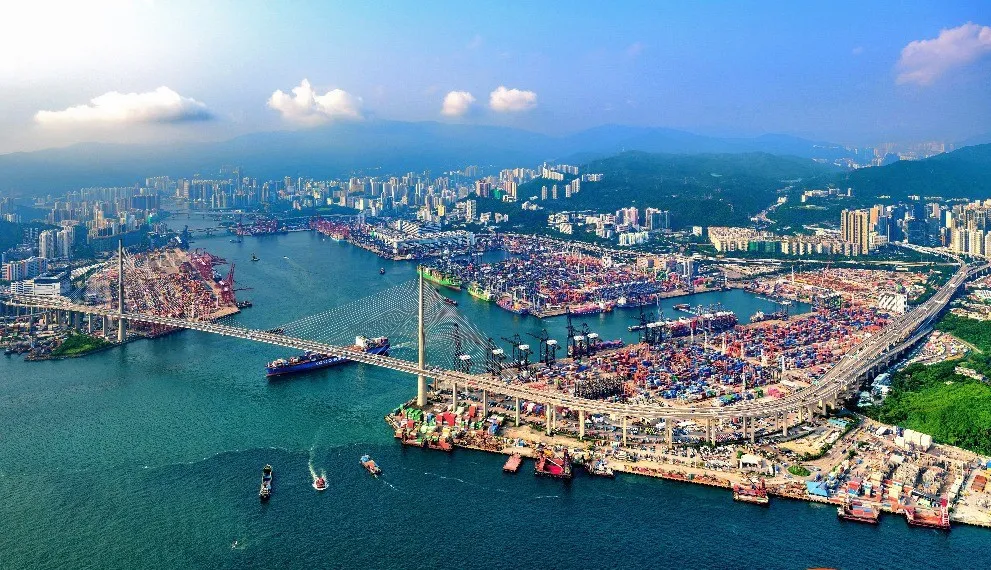
An aerial view of the Port of Hong Kong.
Chan said Hong Kong and Hainan had long maintained close trade ties and that Hong Kong businesses had invested in Hainan’s development. Attracting more Hong Kong maritime service companies to invest in Hainan would build on those ties and allow both sides to make better use of their strengths.
Jacky Chung, Associate Executive Director of the Hong Kong Trade Development Council, said he expected cooperation to deepen now that the two ports were partners. He hoped closer ties would help shape industrial and supply chains in both places and position Hainan and Hong Kong as a strategic link in global networks.
Elin Wong, Corporate Affairs Manager at Modern Terminals Limited, emphasized that shipping companies’ priority was to move cargo in and out of ports quickly and flexibly. Hong Kong’s cooperation with other ports in China and overseas was already showing results, she said. She hoped the partnership with Yangpu would make it easier for ships to move between the two ports, simplify procedures, and improve services.
Hong Kong is Hainan’s largest source of overseas investment. The two have made progress in trade, finance, digital development, culture and tourism, and mutual recognition of professional qualifications.
Eleven container liner routes, regular cruise services, and increasingly frequent flights provide a solid foundation for passenger and freight links. There is room for further cooperation in high-end maritime services, green marine fuels, and shipping digitalization.
How the two hubs could work together
The agreement is only the start. What matters now is how closely the ports work together and how far their cooperation extends.
Song Xiangqing, vice president of the China Society of Business Economics and chair of its Free Trade Port (Zone) Committee, said the two ports could combine the advantages of their respective policies. In this dual-hub model, Yangpu would handle and distribute cargo, while Hong Kong would provide high-end maritime services.
Yangpu could leverage Hainan’s island-wide special customs operations to handle inland cargo moving along the New International Land-Sea Trade Corridor. Hong Kong’s established shipping, trade, financial, and legal systems could then help connect mainland cargo, especially from central and western China, to global shipping routes.
The network could also bring goods and resources from Regional Comprehensive Economic Partnership (RCEP) economies and Southeast Asian markets into China. Alongside more frequent container services, the ports could work together on green shipping, shipping finance, bonded transshipment, and cross-border trade settlement. That would deepen Hainan and Hong Kong’s trade ties and allow the two ports to build up their shipping and logistics capabilities together.
Cargo owners could choose between Yangpu and Hong Kong based on freight rates, sailing schedules, and customs clearance times. That would reduce uncertainty when port delays occur or cargo space is tight.
Shipping companies could shift cargo space and vessel capacity between the two ports as needed. Each port could back up the other during peak periods or route disruptions, shortening transshipment waits and making supply chains more resilient.
“The partnership goes beyond adding a few shipping routes or moving a few more containers. It opens up new possibilities for regional shipping,” Song said. “I hope the two hubs will work together to help China steadily advance high-standard institutional opening up and build a stable, reliable regional logistics hub.”

2026 China International Travel Mart to Open in Haikou on December 12
17:16,27-November-2026
How Can Hainan and the Hong Kong SAR Build a Dual-Hub Shipping Model?
17:16,27-November-2026
Exploring Hainan with Gen Z: Students of International Journalism and Communication from Hainan Normal University Take You Into the MPT-EXPO
17:07,27-November-2026
Finding Home in Haikou, One Bowl of Pho at a Time
16:52,27-November-2026
Hainan's Service Trade Reaches 154 Countries and Regions, Exports Up 14.9%
16:52,27-November-2026
See Deepening and Stronger Ties between Hainan and ASEAN
09:34,26-November-2026

Copyright © 2021 hiHainan.All rights reserved.琼ICP备09005000号-13
 thisishainan@163.com
Partner: Hainan College of Foreign Studies