


When Li Kai first led his team into Changxue Village in the summer of 2022, the only access was by dirt road. His "heart sank," he later recalled. But once inside, row upon row of old houses built from volcanic stone struck him as "something truly special."
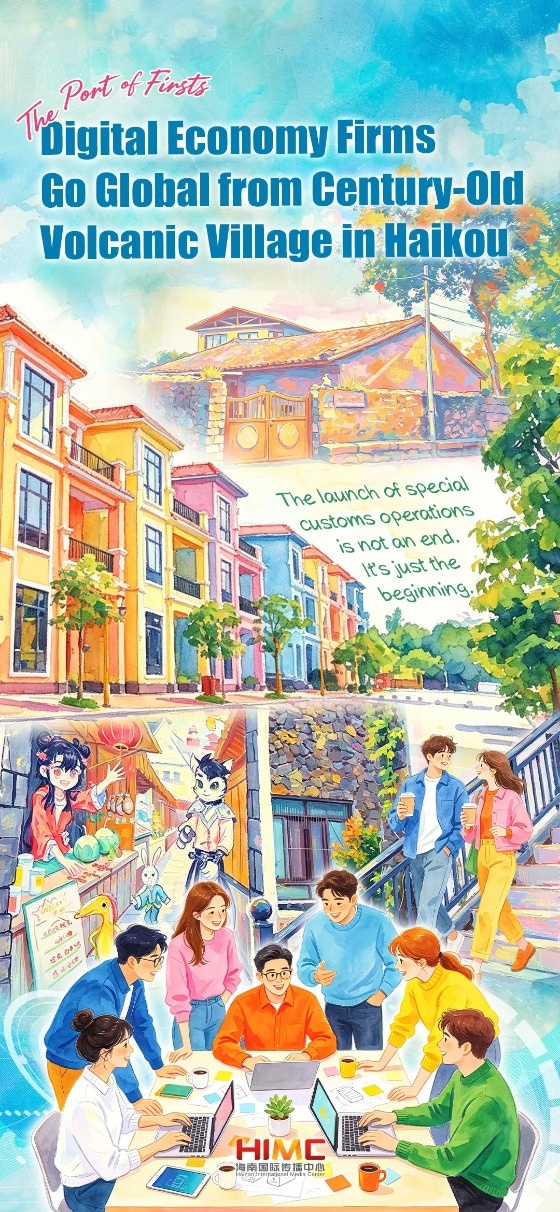
Changxue, a centuries-old village built on the Leiqiong volcanic plains, sits about ten kilometers from downtown Haikou in south China’s Hainan Province. In 2022, Li brought a team of more than 100 people here from Wuhan, 83 of them comic artists. Over the four years since then, they have invested more than 15 million yuan in renovating village houses and workspaces and currently pay over one million yuan in annual rent.
Li, born in the 1980s and trained in finance, made his name by consolidating Zhiyin Manke (Comic Guests), a leading Chinese comic magazine, in 2016. After the pandemic, the team left Wuhan to find a better place to create. The policies of the Hainan Free Trade Port (FTP), enshrined in law, offered stability, and Li believed original Chinese content would inevitably go global. The team decided to settle in Hainan.
The first year in Hainan went well, with revenue of about 120 million yuan. The turn came in early 2023: revenue fell 30 percent, and payment cycles from platforms stretched from one month to three, or even six. "Platforms have to make money even if they don’t get paid; Delaying payments downstream is a normal business choice," Li said. He judged that simply supplying content to platforms had run its course.
In March 2023, after scouting Hainan’s ports, the team ruled out goods trade as a potential new track. Digital content going overseas, which needs no warehousing or logistics—that was where opportunity lay. That August, Li’s company applied for its first dedicated cross-border data channel; four months later, the full chain was running: overseas operations, offshore structures, and a route for earnings to flow back.
Getting the money home was the hardest part. Li completed outbound direct investment (ODI) filings through his Hainan company and set up companies in Hong Kong and Singapore. Repatriation runs through the Hainan FTP’s multi-functional free-trade accounts (EF accounts): an EFN account (denominated in foreign currencies) for the overseas company and an EFE account (denominated in CNY) for the one inside the port, used in tandem to bring earnings home in compliance. Li shared the pathway for free; today nearly 20 park companies take overseas orders or do business overseas.
In December 2023, Li’s team signed with Haikou’s Longhua District to jointly build the Longhua Animation Industrial Park, centered on Changxue and involving five villages. The company, once recruited as a tenant, became the park’s operator through a joint venture with a district-owned investment company.
"The government handles opening up scenarios, implementing policies, and building infrastructure," Li said, "For companies, the rest should be market-driven." For prospective tenants, the park asks first what business they can deliver, rather than what incentives they can get from policies laid out by local government.
This "business first, policy second" order comes from Li’s reading of digital nomads: many such communities elsewhere, he argues, are essentially guesthouses — people come, stay a while, and leave. His answer is to turn nomads into "herders." "Herders pitch their tents and stay," he said. "If grass keeps growing here and there is food to eat, they will stay." The grass is the industrial ecosystem. The park helps companies land their first orders, provides tax and legal support, and brokers collaboration.
According to Li, a workstation at the park—internet, utilities, and property management included —costs less than 10,000 yuan a year. Over 80 percent of the tenants are "digital micro-entities" of one to three people. The park has also launched the OPC Digital Creative Workshop to incubate one-person companies.
Yixuan Culture was one such OPC. The company runs a paid knowledge service on traditional Chinese culture and moved from Guangzhou in March 2025. Founder Zhang Kaicheng saw the Hainan FTP’s "dual 15 percent" tax incentives online and came skeptical; he spent a week verifying with tax authorities and agencies that it was national policy before relocating. Today, his five-person team has one million followers across platforms and is a major taxpayer in Longhua District, paying several million yuan in the first half of 2026. Their next milestone is going global, starting with Southeast Asia’s Chinese-speaking communities and a Hong Kong subsidiary in the pipeline.
Yubai, a Gen-Z AI comic creator, came to the park in 2024 as a comic assistant and now leads an AI animated short drama project for overseas markets. The team, he said, can finish about 16 colored pages a week by hand; with AI, that rises to over 60 pages a day.
For the comic team’s AI transition, 2024 was the "year of growing pains": revenue kept falling while R&D spending climbed. That September, Typhoon Yagi tore the roof off the office building and rainwater wrecked more than 70 computers, delaying the second-phase block under construction.
In March 2025, the second phase, the Haikou Dopamine Digital Nomad Community, officially opened, becoming Haikou’s first digital nomad community. "Dopamine" stands for happiness, and the community aims to be "a gathering place for interesting souls." In the year since, the number of companies in the park has doubled to more than 130. In October 2025, the Cyberspace Administration of China designated the park a dedicated cross-border data channel pilot, the province’s only one for inbound data processing.
The park's bridging role is already taking shape: resident companies take data annotation orders from abroad and help Chinese AI developers collect data in Southeast Asia; Li’s team has content partnerships in South Korea, Japan and the United States; AI animated short drama companies once serving only the domestic market are going global through the community’s overseas partners.
"Hainan must be an international Hainan," Li said, looking ahead, "To become an international community, a bridge for the digital economy between the world and China, and a bridge for Chinese culture going global, that is our long-term vision for this community."
For companies still watching from the sidelines, he has an invitation: "Hainan’s island-wide special customs operations are not an end, but a beginning. Many roads are yet to be built, but once you blaze one, it is your own."
The Port of Firsts: Digital Economy Firms Go Global from Century-Old Volcanic Village in Haikou
12:12,23-September-2026
World NEV Congress Opens as Hainan Eyes Export Service Hub
12:12,23-September-2026
Hainan's Wintering Waterbirds Top 40,000 as Rare Bird Numbers Hit New Highs
17:00,22-September-2026
Haikou-Wenzhou Cargo Route Connects Southeast Asia to the Yangtze River Delta
17:00,22-September-2026
Pinglu Canal Opens, Allowing New Opportunities to Flow to Yangpu
21:56,20-September-2026
Haikou Draws Growing Interest from Russian-Speaking Markets
21:56,20-September-2026

Copyright © 2021 hiHainan.All rights reserved.琼ICP备09005000号-13
 thisishainan@163.com
Partner: Hainan College of Foreign Studies