


HAIKOU, Sept. 19, 2026 — A cargo ship carrying the first batch of goods transported through the newly opened Pinglu Canal has arrived at Yangpu Port in Hainan, highlighting a new connection between southwest China, Hainan and international markets.
The Guangxing 798, operating on the Nanning–Yangpu route, docked at Yangpu Port on September 18, two days after setting out from Nanning. The shipment included the first batch of cargo transported through a rail-river-sea intermodal route following the official opening of the Pinglu Canal on September 16.
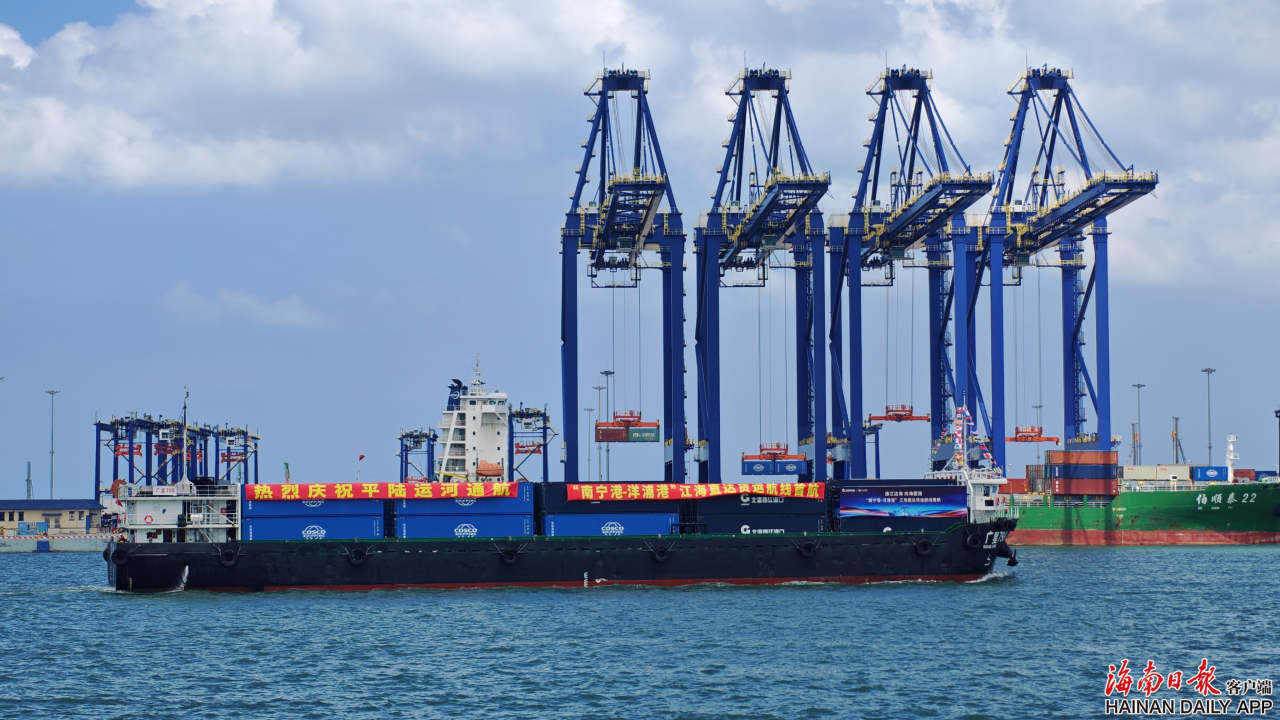
(Photo: Chen Yuancai/Hainan Daily)
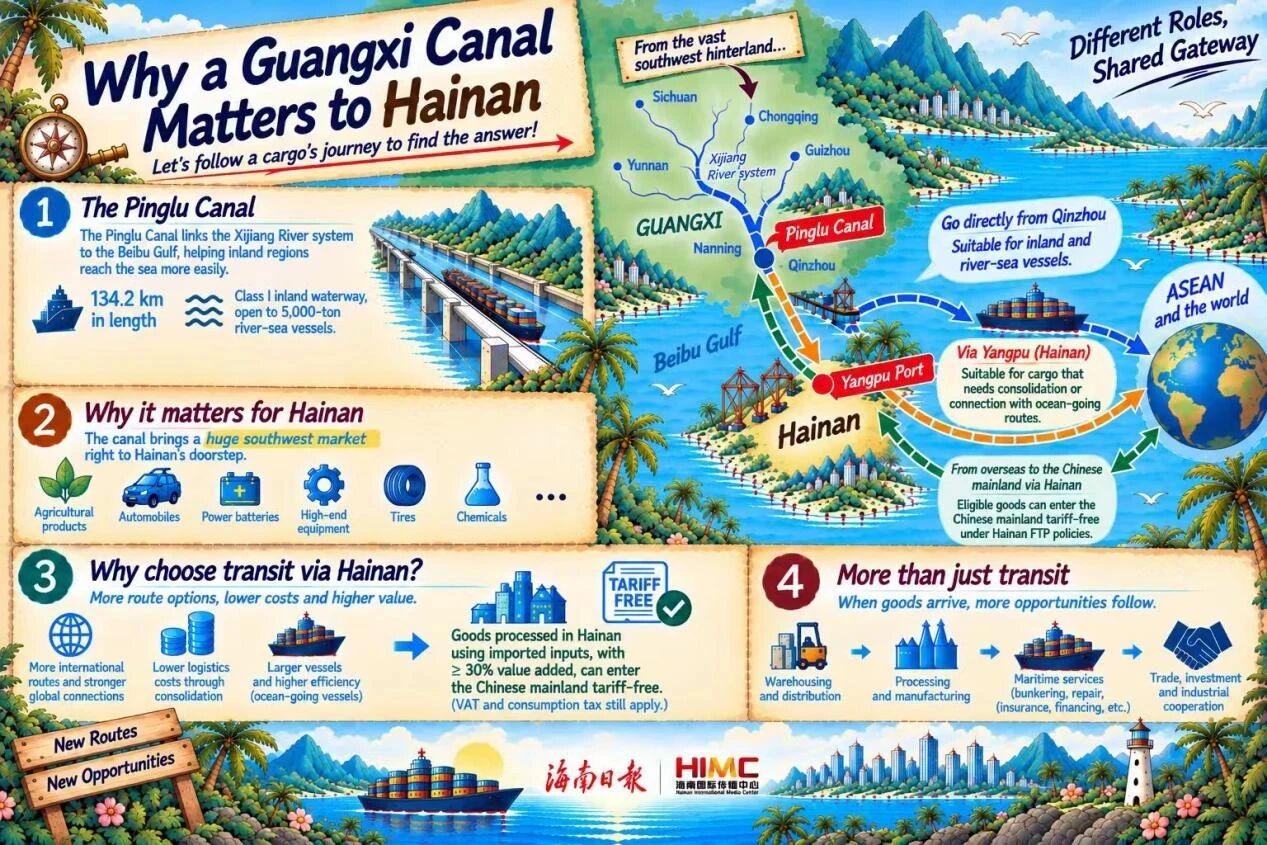
The 134.2-kilometer canal runs from Hengzhou in Nanning, Guangxi, through Qinzhou and into the Beibu Gulf. As a key project of the New International Land-Sea Trade Corridor, it provides southwest China with a shorter and more efficient route to the sea.
But for many of the goods using the canal, reaching the sea is only the beginning.
From canal to international shipping hub
Although the Pinglu Canal does not pass through Hainan, its opening is creating a closer logistics link between southwest China and Yangpu Port.
In April, Hainan and Guangxi signed a cooperation framework agreement to strengthen connectivity between the two regions and develop a logistics route linking Yangpu Port, Beibu Gulf ports and the Pinglu Canal.
The logic is straightforward: the Pinglu Canal brings cargo from southwest China to the coast, while Yangpu provides access to international shipping networks and the institutional advantages of the Hainan Free Trade Port.
Yangpu Port is a deep-water port located close to major international shipping routes in the Beibu Gulf. Its growing network of international routes provides another option for goods from inland provinces seeking access to ASEAN and other overseas markets.
The two sides have already built a foundation for cooperation.
Over recent years, multimodal routes linking Chongqing, Qinzhou and Yangpu have become increasingly regular. The Yangpu and Beibu Gulf ports have also established more than 10 container routes, with container traffic between the two ports reaching 353,000 TEUs in 2025.
With the Pinglu Canal now open, the flow of goods between southwest China, the Beibu Gulf and Yangpu is expected to increase further.
Why continue to Yangpu after reaching the coast?
Qinzhou Port remains one of the most convenient maritime gateways for cargo transported through the Pinglu Canal. So why would some cargo continue across the Beibu Gulf to Yangpu?
For companies, the answer lies in logistics costs, efficiency and the services available at Yangpu.
For the Guangxi Liuzhou-based Yufeng Group, one of the cargo owners on the inaugural rail-river-sea route, the new logistics chain — Liuzhou–Nanning Port–Pinglu Canal–Yangpu Port — provides a new option for exporting goods to ASEAN markets.
The route enables cargo to be transported directly to Yangpu, where it can connect with international shipping services.
More importantly, Yangpu offers functions beyond simple transportation.
In August 2024, Hainan Free Trade Port’s first international transshipment consolidation business was launched in Yangpu, allowing cargo from multiple owners to be consolidated into shipments and helping reduce transportation costs.
In March 2025, a pilot program was introduced to facilitate the supervision of export containers transshipped through Yangpu under an international-transshipment model. Goods from Guangxi and other areas bound for Southeast and South Asia can therefore benefit from more streamlined customs procedures when transshipped through Yangpu.
A series of other policies, including departure-port tax rebates, bonded fuel bunkering, zero-tariff treatment for imported vessels and VAT rebates for internationally sailing vessels built domestically, are also strengthening Yangpu’s role as a logistics and shipping hub.
Together, these measures allow Yangpu to provide services ranging from cargo consolidation and transshipment to processing and other value-added activities.
Rather than competing directly with Qinzhou Port, the two ports can perform complementary functions: Qinzhou can focus on cargo collection and river-sea transfers from the southwest, while Yangpu can leverage the Hainan Free Trade Port policies to expand international transshipment and distribution services.
From a transport route to a value chain
The significance of the Pinglu Canal for Hainan may go beyond moving more cargo through the island.
In April, the Pinglu Canal Group and Hainan Expressway signed a cooperation agreement to explore business opportunities in areas including aggregate trading, entrusted processing and integrated building-material supply chains.
The idea reflects a broader possibility: the canal can become more than a transport route. It can help create an economic corridor connecting inland production, Hainan-based processing and global distribution.
Experts say the combination of increased cargo flows brought by the Pinglu Canal and the institutional advantages of the Hainan Free Trade Port could create a “physical connectivity + policy advantages” effect, further strengthening Hainan’s role as a hub connecting China with ASEAN markets.
For businesses, this could open new models such as:
Southwest China production → value-added processing in Hainan → global distribution
Examples are already emerging.
A nut trader from Hunan has used Hainan’s value-added processing policy to develop a business model involving direct sourcing from Africa, processing in Hainan, distribution in Hunan and sales across China.
Medical companies from Chongqing have also established operations in Hainan, exploring models that combine research and development in Chongqing, manufacturing in Hainan and exports to international markets.
In this sense, cargo arriving in Hainan can represent more than another leg of a logistics journey. It can become the starting point for additional trade, processing and distribution activities.
A new link between southwest China and the world
Coffee beans from Yunnan, tea from Guizhou, electronic components from Sichuan and construction machinery from Hunan could all potentially move through this emerging network.
The opening of the Pinglu Canal has shortened the route from southwest China’s inland areas to the sea. Meanwhile, Yangpu Port can provide international shipping connections and Free Trade Port services that help cargo move beyond the coast.
Together, the Pinglu Canal and Yangpu Port are creating a new logistics link between southwest China, Hainan and international markets.
For Hainan, the opportunity is not simply to handle more cargo, but to turn growing logistics into new trade, processing and supply-chain activity.
As more goods move south through the canal and onward through Yangpu, the emerging corridor could deepen economic links between Hainan and southwest China while creating new channels for trade with ASEAN and the wider world.

Pinglu Canal Opens, Allowing New Opportunities to Flow to Yangpu
21:56,20-September-2026
Haikou Draws Growing Interest from Russian-Speaking Markets
21:56,20-September-2026
Hainan Issues CNY 5B Offshore RMB Bonds in Hong Kong
21:56,20-September-2026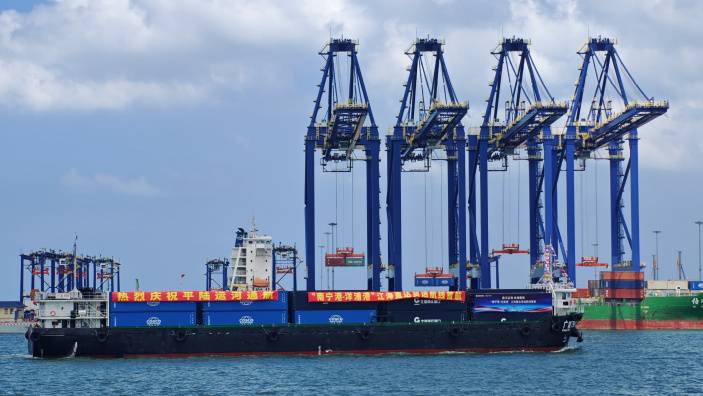
First Rail–River–Sea Cargo via Pinglu Canal Arrives at Yangpu Port
21:55,20-September-2026What Does Hainan Bring to the New International Land-Sea Trade Corridor?
21:55,20-September-2026
Pinglu Canal opens, connecting Southwest China to the sea
11:32,16-September-2026

Copyright © 2021 hiHainan.All rights reserved.琼ICP备09005000号-13
 thisishainan@163.com
Partner: Hainan College of Foreign Studies