


In June, the Southeast Asian-inspired streets of Haikou's Qilou Historical and Cultural Quarter gained a small new shop from Singapore. On June 11, Co+Nut+Ink, a Singapore-based F&B outdoor lifestyle brand, officially opened its first store in China here. For the fit-out, founder Lawrence Tang shipped a batch of patterned Nanyang tiles from Singapore and laid them on the store floor and walls. The tiles are a shared memory of the qilou arcades that grace the islands of Hainan and Singapore. Tang is a third-generation Singaporean of Chinese descent; generations ago, his ancestors left Fujian and Guangdong for Southeast Asia. For him, laying these tiles in a qilou building in Haikou is a declaration: "I'm back in China."
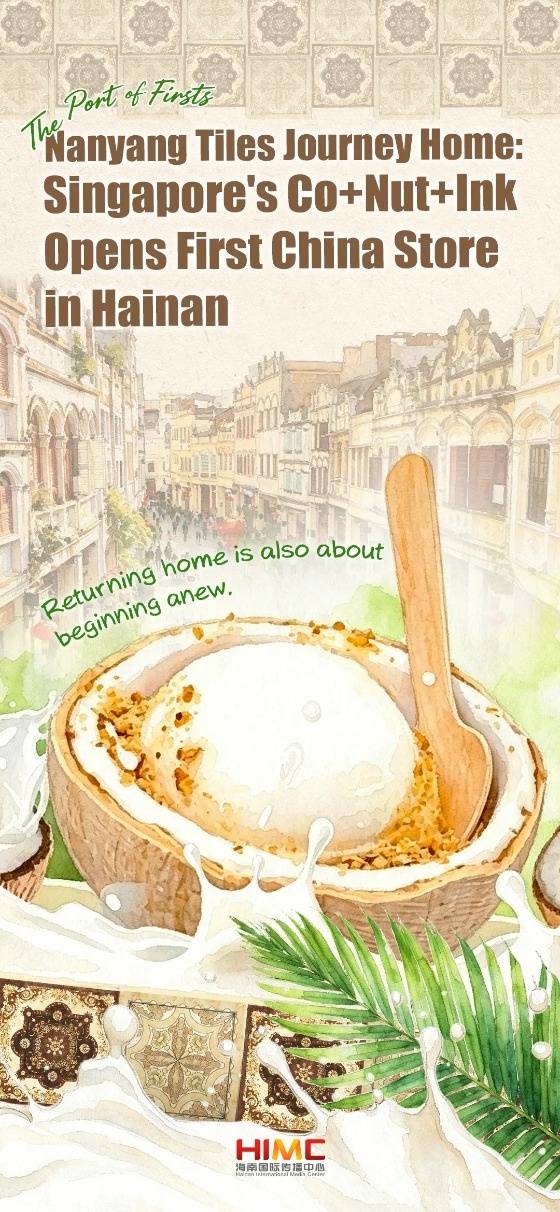
The story of Co+Nut+Ink begins with a cup of coconut ice cream. In 2011, Tang tasted coconut ice cream in Bangkok. Two years later, he brought the recipe back to Singapore and founded the brand in 2013. The recipe also set the brand's ground rules: an authentic formula, healthy, 100 percent vegan products, and a commitment to sustainability.
From that one secret recipe, Co+Nut+Ink has developed more than 50 products, from its signature coconut ice cream and fresh coconut water to 19 kinds of coconut shakes, coffee, and durian ice cream. In Singapore, its five outlets are located at landmark attractions such as Gardens by the Bay and Universal Studios Singapore; beyond Singapore, the brand has expanded to Manila. The Haikou store is its first in China. In 2022, Tang received Singapore's Spirit of Enterprise Award, and the brand has been recognized multiple times by the Singapore Tourism Board and other institutions.
Why choose Hainan for the first store in China? Homeland sentiment is only part of the story. Hainan is a tourism island with a deep coconut culture, a natural fit for a brand whose customers are mainly tourists and young consumers. Born in 1975 and coming from a finance background, Tang has always been cost-conscious. The policies of the Hainan Free Trade Port (FTP) sealed the deal.
As it stands, the math works in two parts. First, operations: enterprises in encouraged industries that are registered in the Hainan FTP and maintain substantive operations there pay a reduced corporate income tax rate of 15 percent, while labor and overall operating costs in Hainan remain comparatively low. Second, the future: goods that increase in value by at least 30 percent through processing in Hainan can enter the Chinese mainland tariff-free, making a future factory in the island province an attractive option.
Beyond policy, there was service. When Tang first came to Hainan on a scouting trip in June 2025, the Hainan International Economic Development Bureau (IEDB) helped him navigate the entire process, from policy consultation to company registration and licensing. That November, the company completed its registration and settled in the Fullsing Internet Information Industrial Park in Haikou, which provides one-stop services such as government-enterprise matchmaking and business resource coordination.
It wasn't all smooth sailing. Because customs was reviewing this type of ice cream for the first time, import approval took about two and a half months. Even so, less than a year passed between Tang's initial scouting trip and the store's official opening.
Co+Nut+Ink is no isolated case. Since the Hainan FTP launched its island-wide special customs operations in December 2025, foreign-invested companies have been accelerating their expansion into the island. In the first half of 2026 alone, 1,303 new foreign-invested enterprises were registered in Hainan, up 38.62 percent year on year.
One store is only the beginning. In the next two years, Tang plans to set up a factory in Hainan. The brand's self-developed robotic self-serve machine, which the company describes as a world-first, has received a patent, with production planned in partnership with Chinese manufacturers, using Hainan as a springboard to bigger markets. "This is the first step for the brand out of Singapore," he said. "We hope to use Hainan as a gateway that will help us expand the brand to other parts of China and to global markets."
More than a century ago, people from the Chinese coast left China for Nanyang, Southeast Asia. Today, patterned tiles and coconut ice cream are making the journey back. For Tang, laying the tiles in his firm's new Qilou store and building a factory in Hainan is both a homecoming and a journey anew.
Unlocking Haikou in 24 Hours: From the Historic Quarter to FTP Development
21:19,24-August-2026
Lingshui: Cable Car Over the Sea, Monkey Islet Encounters
21:19,24-August-2026
The Port of Firsts | Nanyang Tiles Journey Home: Singapore's Co+Nut+Ink Opens First China Store in Hainan
16:41,24-August-2026
Hainan Through Culture: Chushu – A Taste of Autumn on the Island
16:41,24-August-2026
2026 Wenchang Aerospace Forum Set for August 24–26
16:41,24-August-2026
Wanning: Half-Day Aroma, Half-Day Waves
16:41,24-August-2026

Copyright © 2021 hiHainan.All rights reserved.琼ICP备09005000号-13
 thisishainan@163.com
Partner: Hainan College of Foreign Studies