


At the eighth China International Import Expo (CIIE) in November 2025, Dun & Bradstreet unveiled Global CHA (Longyicha龙易查), its first consumer-facing mobile app for the Chinese mainland market. From a smartphone, users can look up the registration details, ownership structures, risk records and credit ratings of nearly 900 million companies worldwide. For the 184-year-old commercial data firm, which has operated in China since 1981, it was the first time its enterprise-grade data capabilities were delivered directly to individual users in a lightweight app.
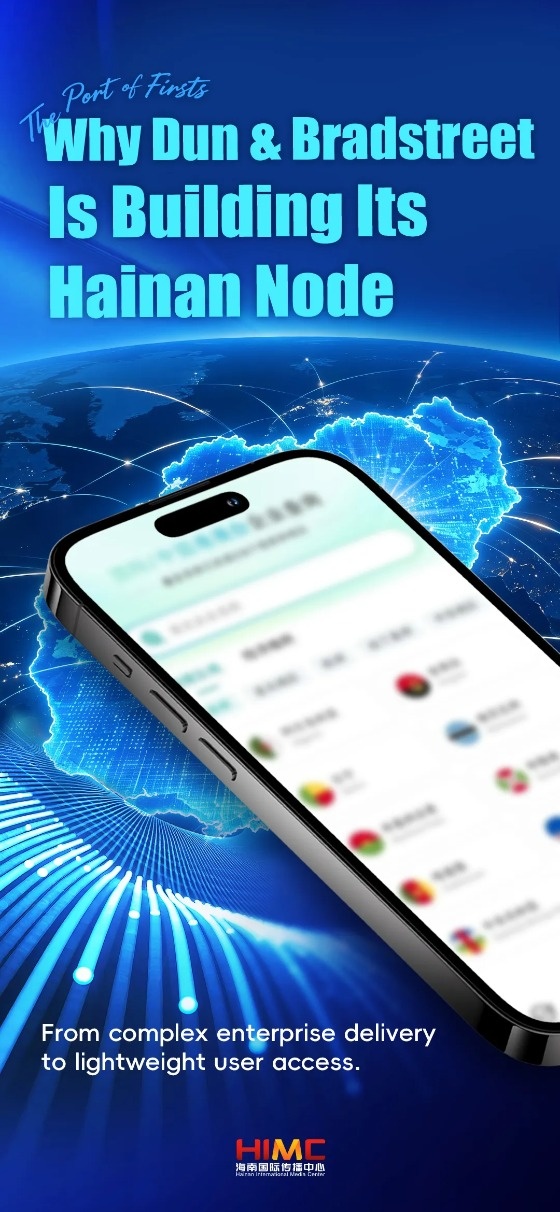
The product's birth is inseparable from the Hainan Free Trade Port (FTP). Behind it lies institutional innovation in two areas where the FTP has piloted new rules: cross-border data flows and the further opening-up of value-added telecommunications services.
For decades, Dun & Bradstreet's business model centered on enterprise data feeds. Onboarding a client typically meant months of system integration and IT testing — resulting in long delivery cycles and high barriers to entry. As early as five or six years ago, the company's management envisioned a product that could reach end users directly, but the idea was shelved, constrained by licensing requirements for value-added telecom services and by data compliance rules.
The turning point came in June 2020, when China released the Master Plan for the Construction of the Hainan Free Trade Port. The plan pledged to promote "the secure and orderly flow of data" and "the further orderly opening-up of value-added telecommunications services." These two provisions directly addressed the twin bottlenecks Dun & Bradstreet had faced for years: how data could enter China compliantly to serve the local market, and whether a foreign-invested company could obtain a license to conduct business online and reach a broader user base at a lower threshold. Together, the two policies provided multinational data service providers with a comprehensive framework for market access and operations.
Betting on this policy combination, Dun & Bradstreet registered a wholly owned subsidiary in 2022 at the Haikou Fullsing Internet Industrial Park, one of the Hainan FTP's 13 key industrial parks. At the end of 2023, the company passed the Cyberspace Administration of China's outbound data security assessment. In February 2025, it was approved as one of the country's first foreign-invested companies to be admitted to the pilot program for value-added telecommunications services. Andrew Wu, CEO of Dun & Bradstreet China, put it bluntly: "If we hadn't chosen Hainan, this product probably still wouldn't exist."
To date, Global CHA has attracted more than one million unique user visits, with queries on overseas companies continuing to climb. Meanwhile, Dun & Bradstreet's Hainan operation now processes data for more than 300,000 Hong Kong companies and handles D-U-N-S Number registration for businesses across China — the nine-digit identifier widely regarded as a "passport" for companies entering global supply chains. Hainan is evolving from a simple policy foothold for the firm into its Asia-Pacific node for data processing, product innovation and market services.
In the AI era, the value of data is shifting from being "searchable" to being "callable" — data that can be consumed by AI models and agents to support trustworthy business decisions is offering those who control it a new competitive edge. Wu said the company will bring more of its global data to Hainan and hopes more upstream and downstream players will join in to form an open data service ecosystem.
For Wu, the Hainan node marks a transition, "turning Dun & Bradstreet China into China's Dun & Bradstreet" — a multinational company that, thanks to the FTP's opening-up policies, can localize and innovate like a domestic player. He still recalls his reaction upon first reading the phrases "further orderly opening-up of value-added telecommunications services" and "secure and orderly flow of data" in the 2020 master plan: "We hadn't seen anything like it anywhere else. It fit exactly what we wanted to do. So, we chose Hainan."
Looking ahead, Wu offers an analogy: if an AI agent were a person, chips and storage would be its body, the model its brain — and data the air it breathes and the water it drinks. "Our job is to make sure the water is clean and the food healthy." Today, global data continues to flow into Hainan through this compliant channel — from the Global CHA app in the hands of a million users to the D-U-N-S Numbers assigned to an increasing number of Chinese companies. The firm, with a story stretching back over 180 years, is writing a new chapter on the Chinese market in Hainan.

Lecheng: 1st China Use of Singapore-developed Bioabsorbable Bone Repair Material
16:00,06-August-2026
Lecheng: Brand New IV Cell Therapy Offers Limb Preservation Hope
15:59,06-August-2026
Haikou Customs Processes $153,000 in Departure Tax Refunds in First Month of New Policy
15:59,06-August-2026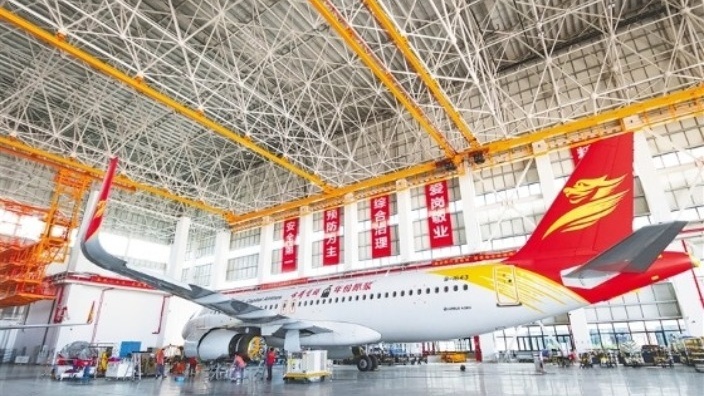
H1: Hainan Imports ¥36.1 Billion in Bonded Maintenance Goods
15:58,06-August-2026
The Port of Firsts | Behind an App: Why Dun & Bradstreet Is Building Its Hainan Node
15:57,06-August-2026
Pennsylvania Meets Hainan on the Pitch
15:57,06-August-2026

Copyright © 2021 hiHainan.All rights reserved.琼ICP备09005000号-13
 thisishainan@163.com
Partner: Hainan College of Foreign Studies