


Recently, a young patient in a ward at the Second Affiliated Hospital of Hainan Medical University, who had been in a coma for over two months following a car accident, was fitted with a black EEG (electroencephalogram) cap. This black, wire-strewn headgear is busy capturing his faint brainwave signals, seeking a breakthrough within the silent realm of consciousness.
Elsewhere, in a lab at Hainan University, several homegrown brain-computer interface chips, each the size of a fingernail, have been developed. They function as miniature "neural hubs" that help create new communication channels between the brain and external devices.
Non-invasive rehabilitation and invasive chip development—two technological approaches that both point towards the same "industry of the future": brain-computer interfaces (BCIs). Hainan, standing at the cusp of this frontier field, is currently ramping up its own BCI layout, the eyes of the world watching in anticipation.
Mind-driven rehabilitation: passive treatment makes way for active involvement
At the Geriatric Hospital of Hainan, a 72-year-old stroke patient, Mr Li, was given a lightweight, wireless EEG cap to wear during a special rehabilitation session. He was asked to focus on the screen and imagine lifting his left hand. Sure enough, the virtual fingers on the screen slowly began to move.
"The hand on the screen actually moved just by me thinking about raising my hand. It's amazing!" he exclaimed.
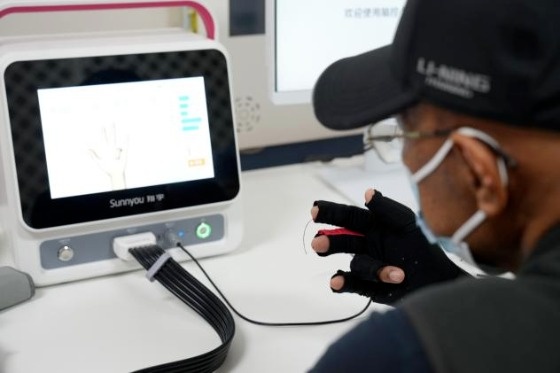
A patient performs BCI-supported finger rehabilitation training. (Photo: Chen Yuancai / Hainan Daily)
This real-life demonstration reflects the core operating principle behind BCIs: every intention in the brain generates specific electrical signals. A device, such as an EEG cap or an implanted chip, collects these signals, while the computer linked to it decodes them and converts them into control commands that are fed to a device, forming a closed feedback loop that promotes neural remodeling.
Wang Jianqiang, director of the hospital's rehabilitation center, explained that traditional rehabilitation training relies on one-on-one assistance from therapists, with patients passively receiving treatment. In contrast, BCIs allow patients to actively participate through mental intention, more fully leveraging the brain's plasticity. Since the introduction of this technology last December, the hospital has completed treatment cycles for 32 patients, with 65% being post-stroke motor disorder cases and 24% Parkinson's disease patients.
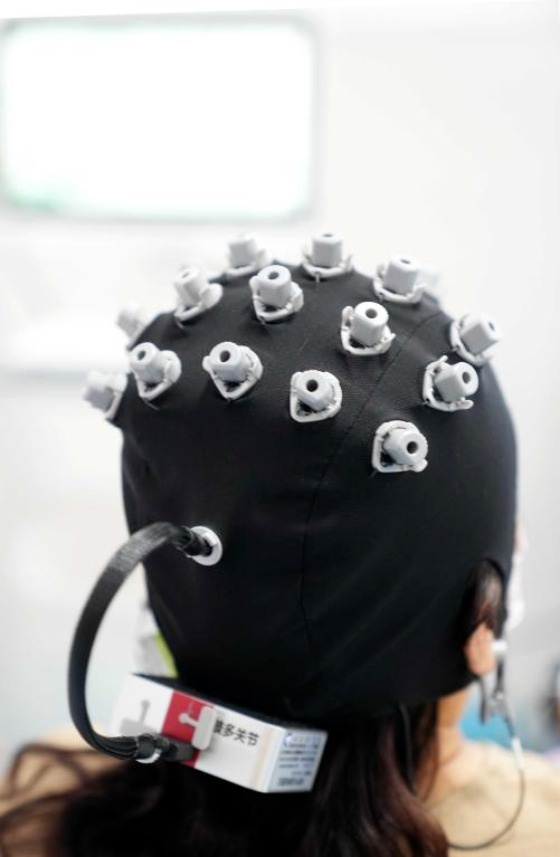
A patient undergoes neurological rehabilitation using a BCI. (Photo: Chen Yuancai / Hainan Daily)
Breakthrough in domestic chips: from trailing to keeping pace
In the field of invasive BCIs, chips are key to determining performance. In the past, these chips were largely imported. However, at the urging of Dr. Luo Qingming, an academician of the Chinese Academy of Sciences, the Brain-Computer Chip Neural Engineering Team at Hainan University was established in 2020 to develop independent, fully controllable technology.
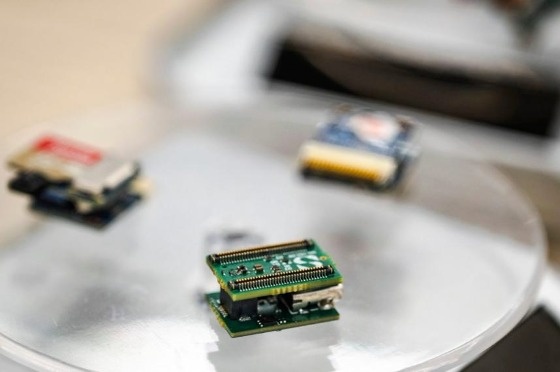
The latest high-density neural signal acquisition device developed by SensingX (Hainan) Co., Ltd. It has doubled the number of acquisition channels while maintaining a size similar to mainstream acquisition devices on the market, ensuring that brain science research can obtain more complete neural activity data. (Photo provided by the Brain-Computer Chip Neural Engineering Team at Hainan University)
After years of research, the invasive brain-computer interface chip developed by the team is now among the most powerful within China. Compared internationally, their 128-channel acquisition chip, shown off in 2025, has doubled the number of channels compared to similar mainstream products overseas, reduced power consumption by over 80%, and shrunk the size by 50%. The team has developed a full-chain product line covering signal acquisition, neural modulation, and wireless transmission, with nearly 20 patents in the pipeline.
To accelerate the clinical and commercial translation of its research findings, Hainan University has established a dedicated company, SensingX. So far, three of their chips have been purchased and tested by more than 30 domestic medical device manufacturers and research institutions. The next-generation 1024-channel ultra-low-power chip is currently being tweaked, with expected power consumption lower than offerings from Elon Musk's Neuralink.
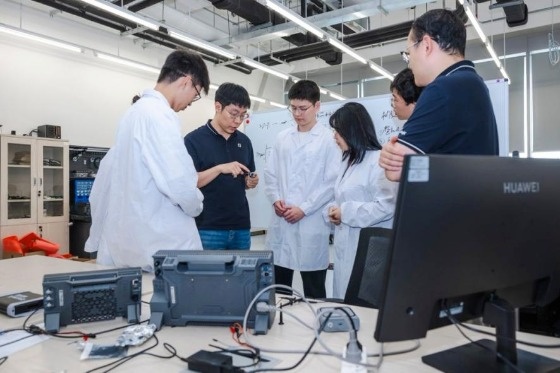
Staff and students from the Brain-Computer Chip Neural Engineering team at Hainan University discuss progress in chip testing. (Photo provided by the Brain-Computer Chip Neural Engineering Team at Hainan University)
Challenges and opportunities: exploring uncharted territory
While progress is promising, challenges remain for BCIs as the technology transitions from the lab to field application. Currently, surgery requires micron-level flexible electrodes to be precisely delivered deep into the brain, described as "threading a needle through wobbling jelly." The chips themselves are classed as high-risk Class III medical devices, with a market approval process that typically takes 5 to 8 years. There is also a disconnect between medicine and engineering in clinical practice, exemplified by a lack of deep collaboration between chip developers and surgeons.
But changes are happening. A team from Hainan University has collaborated with the Second Affiliated Hospital of Hainan Medical University to provide diagnosis and rehabilitation intervention for a 20-year-old comatose patient with consciousness disorders. In January this year, the Hainan Innovation Center for Brain Spatial Informatics and Brain-Computer Interface Technology was inaugurated, establishing clinical transformation bases with multiple hospitals to clear "university R&D + hospital validation" pathways.
Hainan FTP a vital platform
The experts we spoke to believe that Hainan's FTP policies are one of its core competitive strengths. Zero tariffs, low tax rates, and a simplified tax regime, along with cross-border data-flow pilots, can significantly reduce landing and operational costs for innovation entities. The Medical Products Administration of Hainan Province recently introduced ten dedicated measures to provide comprehensive support across the entire "R&D—clinical trials—transformation—regulation" chain for BCI-related medical devices.
Dr. Zhang Xu, an academician of the Chinese Academy of Sciences, suggested that Hainan should focus on core competitiveness in software and algorithms. Once breakthroughs are made in the underlying technologies for decoding advanced brain functions, the achievements can benefit both China and the world. The key to achieving this, in his view, is to leverage the FTP's welcoming policies to attract international talent in mathematics and algorithms.

Why Do Neighbors Gather Under a 200-Year-Old Tree in China?
17:29,23-October-2026
Dual Submarine Cables Cut Hainan-Singapore Latency by 9 Milliseconds
17:29,23-October-2026
Hainan Through Culture: Shuangjiang – The Island’s Late-Autumn Table
17:29,23-October-2026
Nephrospec launch event highlights clinical care and research in chronic kidney disease and hypertension
17:29,23-October-2026
$44.9 Billion Investment in Hainan Island-Wide Power System Testing Grounds
17:29,23-October-2026
Day 2 in Hainan: First International Commercial Tribunalof Hainan Free Trade Port:What Fuels Hainan FTP's Business Confidence?
15:55,22-October-2026

Copyright © 2021 hiHainan.All rights reserved.琼ICP备09005000号-13
 thisishainan@163.com
Partner: Hainan College of Foreign Studies