


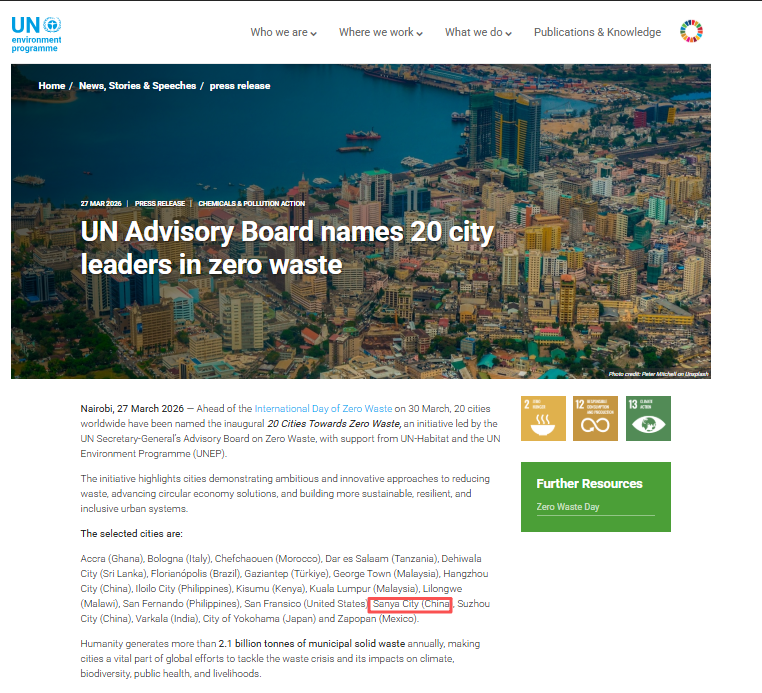
The UN Secretary-General’s Advisory Board on Zero Waste announced the first batch of cities under its “20 Cities Toward Zero Waste” initiative on March 27. Sanya is one of three Chinese cities included in the list. (Source: UN Environment Programme)
As nations across the world explore and implement approaches to sustainable development, eliminating waste has become a crucial concern in urban governance.
On March 27, the UN Secretary-General's Advisory Board on Zero Waste, which promotes local and national zero-waste initiatives, announced the first batch of cities under its "20 Cities Toward Zero Waste" initiative. Sanya in Hainan Province, along with Hangzhou in Zhejiang Province and Suzhou in Jiangsu Province, is one of three Chinese cities included in the list. As a globally recognized coastal tourism city, Sanya is systematically integrating the "zero waste" concept into its urban operations through its "Zero-Waste City" program.
What is "Zero-Waste City"?
"Zero Waste" refers to achieving a virtuous cycle through the effective management of reducing, recycling, and safely disposing of solid waste, while a "Zero-Waste City" is an advanced urban development model guided by the new development philosophy of innovation, coordination, green growth, openness, and sharing. By reducing solid waste generation at the source and maximizing resource utilization, the model helps minimize its environmental impact.
From single-point governance to system integration
Sanya has established a circular-economy industrial park that includes waste-to-energy incineration, medical waste disposal, food waste recycling, construction waste management, municipal sludge treatment, slag utilization, and end-of-life vehicle scrapping. This innovative approach effectively tackles the significant seasonal variations in solid waste production typical of tourist destinations.
In 2025, the waste-to-energy plant's residual heat (steam) supply reached 36,689.91 tons, powering five units within the industrial park. Through efficient resource and energy coupling within the park, annual waste-to-energy power generation has reached approximately 450 million kWh, resulting in an average annual carbon reduction of about 350,000 tons and providing robust support for the city's green and low-carbon development.
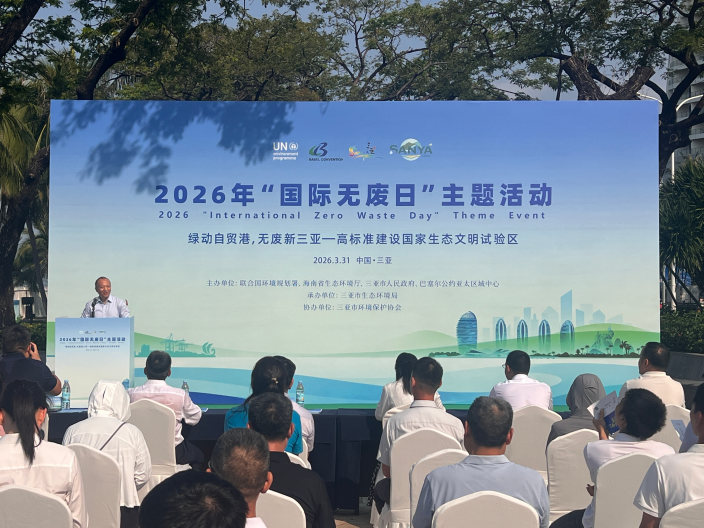
The 2026 "International Zero Waste Day" theme event was held in Sanya City, Hainan Province, on March 31, 2026. (Source: hinews.cn)
Culture-tourism integration highlights zero-waste scenarios
Chen Gaizhong, head of the Soil Division at the Sanya Municipal Bureau of Ecology and Environment, explained that Sanya's successful selection as a model under the UN's "20 Cities Toward Zero Waste" stems from a persistent commitment to and innovation in green development principles.
To date, Sanya has established 676 "zero-waste cells," encompassing 39 "zero-waste hotels," 13 "zero-waste scenic spots," and 410 "zero-waste villages." Xidao Island, located in Sanya Bay, transformed old fishing boats into maritime bookstores, while Luhuitou (Deer Looking Back) Scenic Area created nighttime landscapes using plastic bottles, turning waste into viral photo spots. 1 Hotel in Haitang Bay achieved annual utility savings exceeding CNY 900,000 through renewable material renovations and water recycling, reducing solid waste by 40%, establishing itself as a benchmark for green hotels.
Technology empowering ecological governance
In marine waste management, Sanya has introduced new technologies such as drones and underwater cleaning robots, establishing a multi-layered cleaning network extending from the beach all the way to the sea bed.
In 2024, over 1,182 tons of marine waste were cleared, and in 2025, 30 beach cleanup activities were organized, removing over 2,500 kilograms of waste. Six already-established "beautiful bays" and two additional "beautiful bays" met their development goals, earning Sanya the national title of "Ecological Civilization Construction Demonstration Zone."
Mu Xiaodong, Deputy Director of the Sanya Municipal Bureau of Ecology and Environment, stated that the city will further expand the creation of "waste-free cells" and integrate zero-waste concepts into cultural tourism, sports events, and exhibitions, demonstrating to the world that it is more than its blue seas and skies.
Zero-Waste Sanya: Systemic Integration of the "Zero Waste" Model
16:54,01-April-2026
16 Measures to Ensure Smooth Customs Clearance at 6th CICPE
16:54,01-April-2026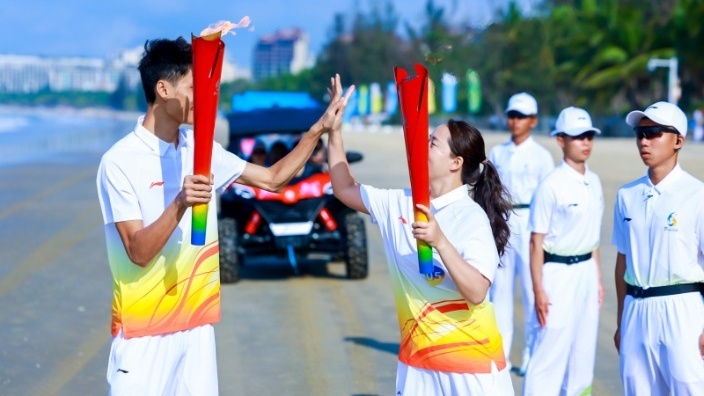
Another Torch Relay Highlights Sanya's Ongoing Transformation
14:38,31-March-2026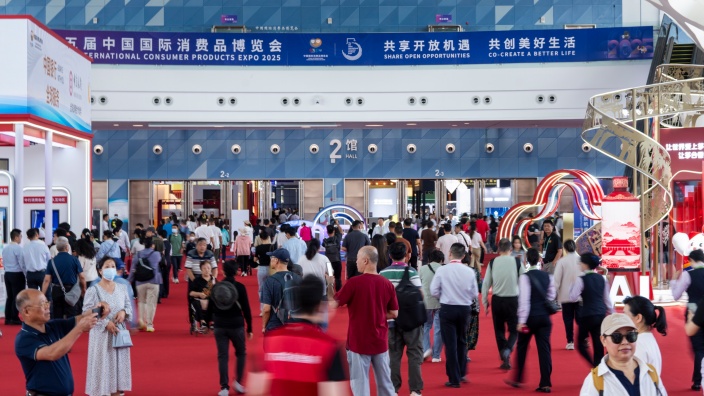
More than 3,400 brands will be on display at the 6th China International Consumer Products Expo in Haikou from April 13 to 18
14:38,31-March-2026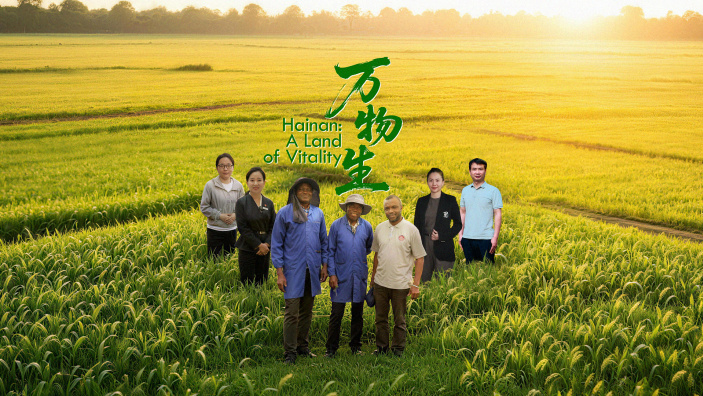
Hainan: A Land of Vitality
14:38,31-March-2026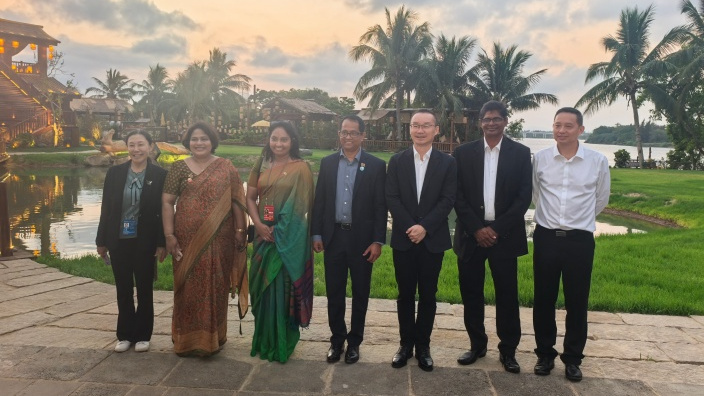
Sri Lankan Delegation Visits Liuke Village in Boao Town
14:58,30-March-2026

Copyright © 2021 hiHainan.All rights reserved.琼ICP备09005000号-13
 thisishainan@163.com
Partner: Hainan College of Foreign Studies