


On October 20, 2026, China's National Development and Reform Commission (NDRC) announced the first group of 136 major projects selected to serve as real-world testing grounds for new technologies and applications. The list includes Hainan's Clean Energy Island New-Type Power System project, jointly proposed by China Southern Power Grid and the Hainan Province government.
The project will set the entire island province as a testing area, with approximately 300 billion yuan ($44.9 billion) in direct investment planned between 2026 and 2030, and is expected to drive more than 800 billion yuan ($119.8 billion) in total investment across related upstream and downstream industries. By testing clean energy integration, energy storage, grid resilience technologies, and operating models in real-world conditions, Hainan aims to develop approaches to cleaner electricity systems that can be applied in other island regions.
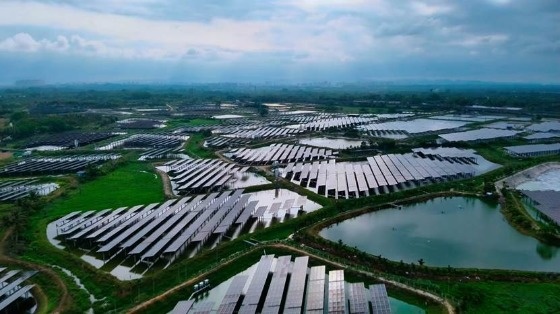
The integrated aquaculture and solar power facility on Dongyu Island in Boao. (Photo by Yuan Sa)
Why Hainan?
As wind and solar power expand, making effective use of variable renewable energy while maintaining grid stability has become a shared challenge in the global energy transition. For islands, the challenge is particularly complex due to limited grid interconnections, the composition of local energy supplies, and exposure to extreme weather.
Hainan offers suitable conditions for testing these technologies. As China's only tropical island province, Hainan has a relatively self-contained province-level power grid with limited connections to the main power network in southern China. The island also enjoys abundant wind and solar resources and is expanding clean energy development alongside efforts to build a new-type power system.
Hainan is also home to China's only free trade port and has been designated a national pilot zone for ecological conservation. The island’s geography, energy mix, and policy environment create opportunities to test different energy technologies and power system operating models across the province, generating experience that will benefit other islands and regions with high shares of clean energy.
Seven Demonstration Areas Span the Entire Power System
Rather than focusing on a single power plant or grid infrastructure project, Hainan's selected initiative is an integrated, province-wide demonstration covering electricity generation, transmission, storage, and use.
The plan sets out seven demonstration areas across Hainan: large-scale clean energy development and integration, resilient island grid infrastructure, a province-wide network of electric vehicle charging and battery-swapping facilities linked to virtual power plants, flexible grid balancing using energy storage and gas-fired generation, offshore power systems, disaster prevention and mitigation for tropical island grids, and integration into China's unified national electricity market.
Together, these demonstrations will provide real-world operating environments for new power technologies, products, and business models. In the electric vehicle sector, Hainan will explore a unified province charging and battery-swapping network and vehicle-to-grid (V2G) technologies. On the supply side, energy storage and flexible gas-fired generation will help the grid respond to fluctuations in renewable power output. Disaster preparedness efforts will focus on making the island's electricity network more resilient to natural hazards.
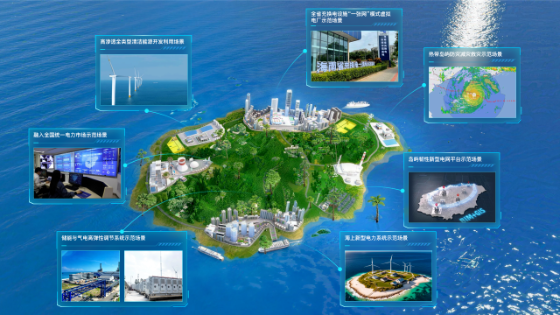
The seven demonstration areas of Hainan's Clean Energy Island New-Type Power System project. (Photo courtesy of Hainan Grid Company)
The project is also intended to support Hainan's green energy industries. Priority areas include offshore wind power and green fuels, digital grids and smart equipment, electric vehicles and V2G technologies, a range of energy storage technologies, energy development in deep and distant offshore waters, disaster preparedness and emergency response, and carbon management services for the power sector.
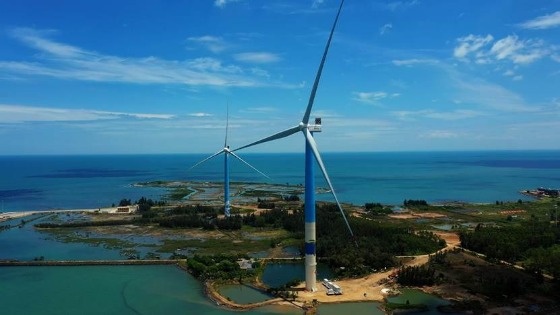
Hainan's first 110-kilovolt offshore wind turbine testing and inspection facility project. (Photo by Lu Xin)
From Clean Power to Grid Resilience
Under the Implementation Plan for Developing Hainan's Clean Energy Island New-Type Power System, released in 2025, Hainan aims to have a province-level demonstration system largely in place by 2030. The planned electricity supply system will rely primarily on new energy sources, with nuclear and thermal power providing backup, supported by a smart digital grid. By then, clean energy is expected to account for more than 90% of the province's installed power generation capacity and over 80% of electricity generation.
Beyond changing the energy mix, the project will also seek to improve the security and reliability of electricity supplies.
Once the project is completed, the target is to reduce the time needed to repair damaged grid infrastructure and restore power after disasters by 70%, with more than half of affected customers expected to have electricity restored within 24 hours. Greater grid reliability would benefit residents in their daily lives while providing more dependable power for major events and activities, including space launches from Wenchang, the Boao Forum for Asia Annual Conference, and the China International Consumer Products Expo.
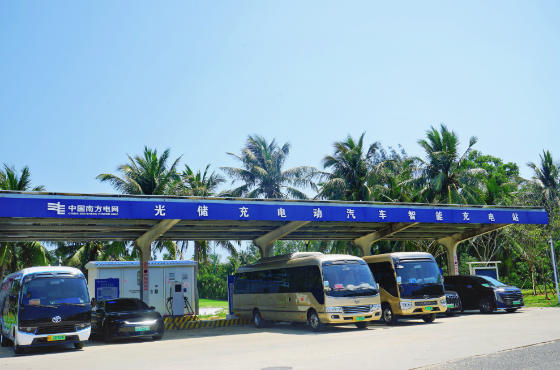
A smart electric vehicle charging station combining solar power generation and battery storage in Boao's Zero-Carbon New-Type Power System Demonstration Zone. (Photo by Chen Liwen)
The expansion of clean electricity also has implications for international trade, particularly for export-oriented businesses in the Hainan Free Trade Port. The project plans to develop systems for tracing the origins of green electricity and certifying carbon emissions, helping exporters meet international green trade requirements, while also exploring cross-border green electricity trading and mutual recognition of carbon standards with international partners.
The general manager of Hainan Grid Company's Strategic Planning Department said the project would focus on testing new technologies, developing related industries, and exploring innovations in power system operations. The aims also include establishing technical standards, operating models, and governance practices that can be replicated and adopted elsewhere.
The lessons learned in Hainan should prove useful to other Chinese islands, coastal regions, and areas with high shares of new energy. Through the Hainan Free Trade Port's international connections, they will also offer insights for green energy development in countries participating in the Belt and Road Initiative and other tropical island regions.

Why Do Neighbors Gather Under a 200-Year-Old Tree in China?
17:29,23-October-2026
Dual Submarine Cables Cut Hainan-Singapore Latency by 9 Milliseconds
17:29,23-October-2026
Hainan Through Culture: Shuangjiang – The Island’s Late-Autumn Table
17:29,23-October-2026
Nephrospec launch event highlights clinical care and research in chronic kidney disease and hypertension
17:29,23-October-2026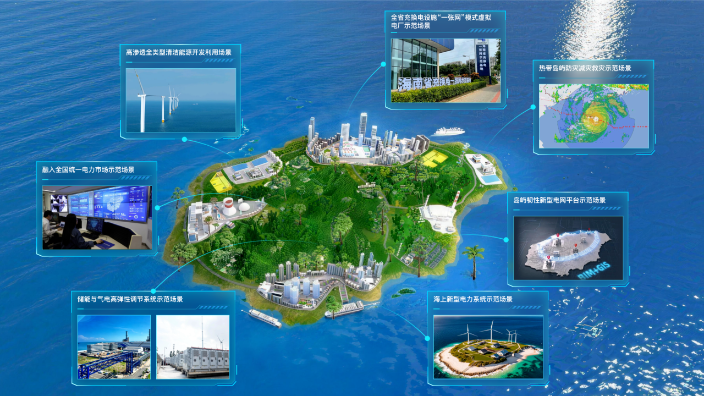
$44.9 Billion Investment in Hainan Island-Wide Power System Testing Grounds
17:29,23-October-2026
Day 2 in Hainan: First International Commercial Tribunalof Hainan Free Trade Port:What Fuels Hainan FTP's Business Confidence?
15:55,22-October-2026

Copyright © 2021 hiHainan.All rights reserved.琼ICP备09005000号-13
 thisishainan@163.com
Partner: Hainan College of Foreign Studies